Today's
EarthStation1.com 15% (Or More!) Off Commemorative Memorial Title:
Franklin D. Roosevelt Documentaries DVD, Video Download, USB Drive
Today, August 21, 2026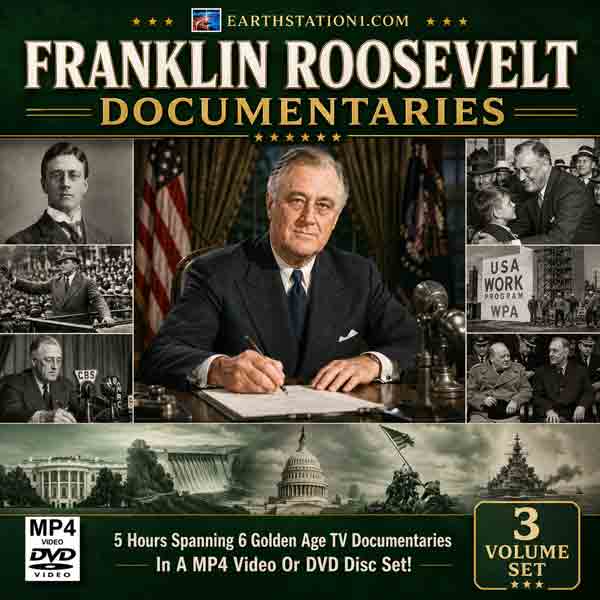
August 21: National Senior Citizens Day:
-- Do you have an elderly person in your life that you love and
appreciate? Then today is the day to let them know how much you
care and it's an opportunity to recognize their accomplishments!
In 1988, President Ronald Reagan proclaimed this holiday to raise
awareness about issues that affect senior citizens and their
quality of life. Today, seniors are still active in their
communities as well as continuing to have a strong presence in the
workforce. For all they do and have achieved for the good of their
communities, senior citizens deserve our thanks! National Senior
Citizens Day recognizes seniors who have spent their lives
contributing to society and have impacted everyone's lives for the
better. Improved healthcare has changed demographics and increased
productivity of older citizens, allowing them to be more active
than ever before. With more opportunities available as well, many
senior citizens now begin second careers and are an example for
younger generations. The country's foundation and stable sectors
are the result of the hard work of our senior citizens and they
deserve all our gratitude. President Ronald Reagan took the
initiative to honor seniors in 1988 when he signed Proclamation
5847 and marked August 21 as the day seniors will be celebrated.
"Throughout our history, older people have achieved much for
our families, our communities, and our country. That remains true
today, and gives us ample reason this year to reserve a special
day in honor of the senior citizens who mean so much to our land,"
Reagan proclaimed. "For all they have achieved throughout
life and for all they continue to accomplish, we owe older
citizens our thanks and a heartfelt salute. We can best
demonstrate our gratitude and esteem by making sure that our
communities are good places in which to mature and grow older -
places in which older people can participate to the fullest and
can find the encouragement, acceptance, assistance, and services
they need to continue to lead lives of independence and dignity."
His words have withstood the test of time and are now, over 30
years later, more important than ever as older people are leading
more productive lives. Reagan himself set an example for everyone
- he was 69 years old when one of the world's most powerful titles
of president of the U.S. was given to him on January 20, 1981.
Reagan lived till the ripe old age of 93, and not only was he the
oldest person to be elected president, he was also the oldest when
his term ended at 77 years and 349 days. According to the U.S.
Census Bureau, approximately 78 million people aged 65 and older
will reside in America by 2035. This figure will surpass the
number of the population under the age of 18 for the first time in
the nation's history. On Sale Until Midnight Tonight PT!
https://store.earthstation1.com/franklin-roosevelt-documentaries-dual-layer-dvd.html
Today's
EarthStation1.com 15% (Or More!) Off Commemorative Memorial Title:
Terror: The Israeli-Palestinian Conflict DVD MP4 Video Download
Today, August 21, 2026
August 21: International Day Of
Remembrance And Tribute To The Victims Of Terrorism: -- A day
dedicated to remembering those whose lives have been irrevocably
impacted by acts of terrorism. Some of them had to say goodbye to
loved ones and many of them require financial and medical
assistance. When the aftermath of a terrorist incident fades,
victims of terrorism sometimes feel abandoned and forgotten. These
victims would fight for their rights to be respected and their
voices to be heard. However, victims of terrorist attacks
frequently lack the resources necessary to completely
rehabilitate. This day was established to recognize and support
survivors of terrorist attacks. In 2017, the U.N. General Assembly
declared August 21 as the International Day of Remembrance and
Tribute to Terrorist Victims, with the goal of honoring and
supporting terrorism victims, as well as promoting and protecting
their human rights and fundamental freedoms. The UN
Secretary-General, Antonio Guterres, released his report on the
"Progress of the UN System to Support Member States in Aiding
Victims of Terrorism" in April 2020, as requested by the
General Assembly. Dehumanization of victims is one of the
conditions that spread terrorism, according to the Global
Counter-Terrorism Strategy, which unanimously adopted a resolution
on September 8, 2006, stating that the most effective way to
combat this is to take measures that respect human dignity and
uphold the rule of law. Since the sixth review in 2018, events at
the international, regional, and national levels have
progressively indicated that victims' assistance has progressed
beyond symbolic solidarity to a more active engagement to promote
their rights and demands. This is evident in the formation of a
Group of Friends of Terrorism Victims in 2019, co-chaired by the
Permanent Representatives of Afghanistan and Spain to the U.N., as
well as a General Assembly resolution on enhancing international
collaboration to aid terrorism victims. The seventh review
resolution, enacted on June 30, 2021, emphasizes the importance of
defending the rights and meeting the needs of terrorist victims,
particularly women, children, and those harmed by terrorists'
sexual and gender-based abuse. On Sale Until Midnight Tonight PT!
https://store.earthstation1.com/terror-the-israelipalestinian-conflict-dvd-mp4-video-downloa4.html
Today's
EarthStation1.com 15% (Or More!) Off Commemorative Memorial Title:
A Rustling Of Leaves: Inside The Philippine Revolution DVD, MP4,
USB
Today, August 21, 2026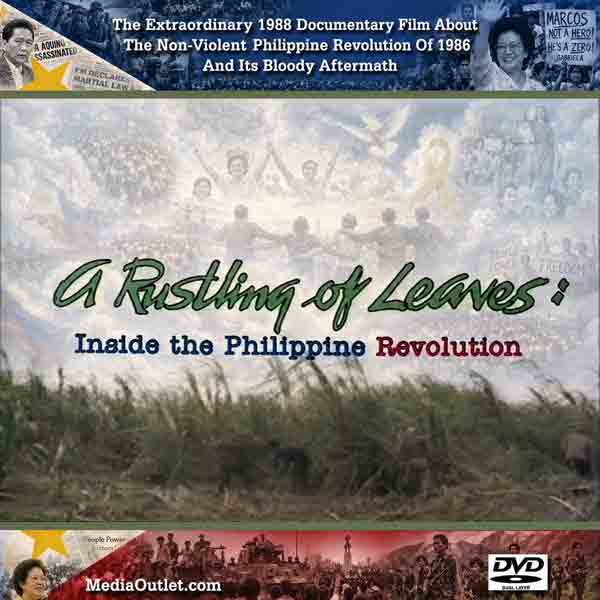
August 21: Ninoy Aquino Day: -- August
21, 1983: The Aftermath Of World War II: The Cold War: The Cold
War (1979-1985): The Cold War Era Of Stagnation (1964-1982): The
Cold War In Asia: Coups In The Philippines: The People Power
Revolution (The EDSA Revolution, The Philippine Revolution Of
1986, The February Revolution, The Yellow Revolution): The
Assassination Of Benigno Aquino Jr.: -- #DOTD: #RIP: Filipino
opposition leader Benigno S. Aquino, Jr., was assassinated at
Manila International Airport (renamed Ninoy Aquino International
Airport in his honor) while leaving his plane. The event is
commemorated annually in the Philippines as Ninoy Aquino Day in
honor of his the life and legacy as a champion of freedom. Public
outcry over the killing ultimately led to the collapse of the
government of Ferdinand E. Marcos and the inauguration of Corazon
C. Aquino, widow of the slain man, as president. Benigno Simeon
"Ninoy" Aquino Jr., a longtime political opponent of
President Ferdinand Marcos, had just landed in his home country
after three years of self-imposed exile in the United States when
he was shot in the head while being escorted from an aircraft to a
vehicle that was waiting to transport him to prison. Also killed
was Rolando Galman, who was later implicated in Aquino's murder.
Aquino was elected to the Philippine Senate in 1967 and shortly
thereafter began speaking out against Marcos's authoritarian rule.
He was imprisoned on trumped up charges shortly after Marcos's
1972 declaration of martial law. In 1980, he suffered a heart
attack in prison and was allowed to leave the country two months
later by Marcos's wife, Imelda. He spent the next three years in
exile near Boston before deciding to return to the Philippines.
Aquino's assassination is credited with transforming the
opposition to the Marcos regime from a small, isolated movement
into a national crusade. It is also credited with thrusting
Aquino's widow, Corazon Aquino, into the public spotlight and her
running for president in the snap election of 1986. Though Marcos
was officially declared the winner of the election, widespread
allegations of fraud and illegal tampering on Marcos's behalf are
credited with sparking the People Power Revolution, which resulted
in Marcos fleeing the country and conceding the presidency to
Corazon Aquino. Though many, including the Aquino family, maintain
that Marcos ordered Aquino's assassination, this was never
definitively proven. An official government investigation ordered
by Marcos shortly after the assassination led to murder charges
against 25 military personnel and one civilian; all were acquitted
by the Sandiganbayan (special court). After Marcos was ousted,
another government investigation under Corazon Aquino's
administration led to a retrial and the conviction of 16 military
personnel, all of whom were sentenced to life imprisonment. Since
their conviction, one of the convicts was pardoned, three died in
prison, and the remainder had their sentences commuted at various
times; the last convicts were released from prison in 2009. On
Sale Until Midnight Tonight PT!
https://store.earthstation1.com/a-rustling-of-leaves-inside-the-philippine-revolution-dvd.html
Today's
EarthStation1.com 15% (Or More!) Off Commemorative Memorial Title:
Know Your Enemy: Japan WWII Frank Capra + The Samurai MP4 Download
DVD
Today, August 21, 2026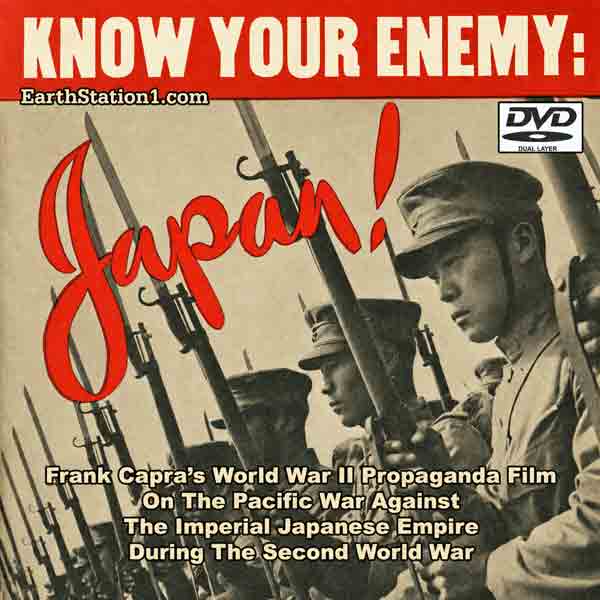
August 21, 1192 (Traditional Japanese
date: The 12th Day, Seventh Month, Third Year Of The Kenkyu Era):
Japan: The History Of Japan: The Kamakura Period (1185-1333): The
Kenkyu Period (1190-1199): Shogunates: The Kamakura Shogunate
(1192-1333): The Minamoto No Yoritomo Shogunate (1192-1199): --
Minamoto No Yoritomo, founder and first shogun of the Kamakura
Shogunate and of Japan, ruling from 1192 until 1199, the first
ruling shogun in the history of Japan, husband of Hojo Masako, who
acted as Shikken (regent) after his death (d. May 9, 1147 -
February 9, 1199) becomes Shogun and thereby the de facto ruler of
Japan. The office of shogun was in practice hereditary, although
over the course of the history of Japan several different clans
held the position. The title was originally held by military
commanders during the Heian period in the eighth and ninth
centuries. When Minamoto no Yoritomo gained political ascendency
over Japan in 1185, the title was revived to regularize his
position, making him the first shogun in the usually understood
sense. It is often said that one must be of the Minamoto lineage
to become a shogun, but this is not true. While it is true that
the Minamoto lineage was respected as a lineage suitable for the
position of shogun, the fourth and fifth shoguns of the Kamakura
shogunate were from the Fujiwara lineage (although their mothers
were from the Minamoto lineage), and the sixth through ninth
shoguns were from the imperial lineage. Oda Nobunaga, who claimed
to be a descendant of the Taira clan, was approached for the
position of shogun a month before his death. Shogun (Officially
(Sei-I Taishogun, "Commander-In-Chief Of The Expeditionary
Force Against the Barbarians") was the title of the military
rulers of Japan during most of the period spanning from 1185 to
1868. Nominally appointed by the Emperor, shoguns were usually the
de facto rulers of the country, except during parts of the
Kamakura period and Sengoku period when the shoguns themselves
were figureheads, with real power in the hands of the Shikken
(Regent) of the Hojo Clan and Kanrei (Deputy) of the Hosokawa
clan. In addition, Taira no Kiyomori and Toyotomi Hideyoshi were
leaders of the warrior class who did not hold the position of
shogun, the highest office of the warrior class, yet gained the
positions of Daijo-Daijin (Chancellor Of The Realm) and Kampaku
(Imperial Regent), the highest offices of the aristocratic class.
As such, they ran their governments as its de facto rulers. The
shogun's officials were collectively referred to as the Bakufu
(Japanese: "Miltary Government"); they were the ones who
carried out the actual duties of administration, while the
imperial court retained only nominal authority. The tent
symbolized the shogun's role as the military's field commander but
also denoted that such an office was meant to be temporary.
Nevertheless, the institution, known in English as the shogunate,
persisted for nearly 700 years, ending when Tokugawa Yoshinobu
relinquished the office to Emperor Meiji in 1867 as part of the
Meiji Restoration. On the other hand, the term bakufu is merely a
term that began to be actively used in the 1800s to emphasize that
the emperor was the legitimate ruler of the country, while during
the Tokugawa shogunate the shogunate was officially called Kogi
(Shogunate Government). Minamoto No Yoritomo was born with the
childhood name Oniwakamaru in Atsuta, Owari Province, Japan, the
third son of Minamoto no Yoshitomo, heir of the Minamoto (Seiwa
Genji) clan, and his official wife, Yura-Gozen, daughter of
Fujiwara no Suenori, High Priest of Atsuta Shrine and a member of
the powerful Fujiwara clan. Minamoto No Yoritomo belonged to Seiwa
Genji's prestigious Kawachi Genji family. After successfully
maneuvering himself to the position of rightful heir of the
Minamoto clan, he led his clan against the Taira from his capital
in Kamakura, beginning the Genpei War in 1180. After five years of
civil war, the Minamoto clan finally defeated the Taira in the
Battle of Dan-no-ura in 1185. Yoritomo established the supremacy
of the samurai caste and the first shogunate (bakufu) which was to
be centered around Kamakura, thus beginning the feudal age in
Japan, which lasted until the 17th century. Minamoto No Yoritomo
was ordained as a Buddhist monk in 1199 and left his home. He
received the Buddhist name Bukoshogendaizenmon (Japanese: "All
Questions On Contemporary Books") two days before he died
aged 51 in Kamakura, Kamakura Shogunate, Japan. He is buried at
The tomb Of Minamoto No Yoritomo, a monument in Kamakura,
Kanagawa, Japan, located some hundred meters north of the site
where the palace called Okura Bakufu, seat of Minamoto Mo
Yoritomo's government, once stood. On Sale Until Midnight Tonight
PT!
https://store.earthstation1.com/know-your-enemy-japan-1945-frank-capra-wwii-film-dvd-mp19454.html
Today's
EarthStation1.com 15% (Or More!) Off Commemorative Memorial Title:
Haiti Killing The Dream 1991 Haitian Coup + 2 Bonuses 2 MP4 Or DVD
Set
Today, August 21, 2026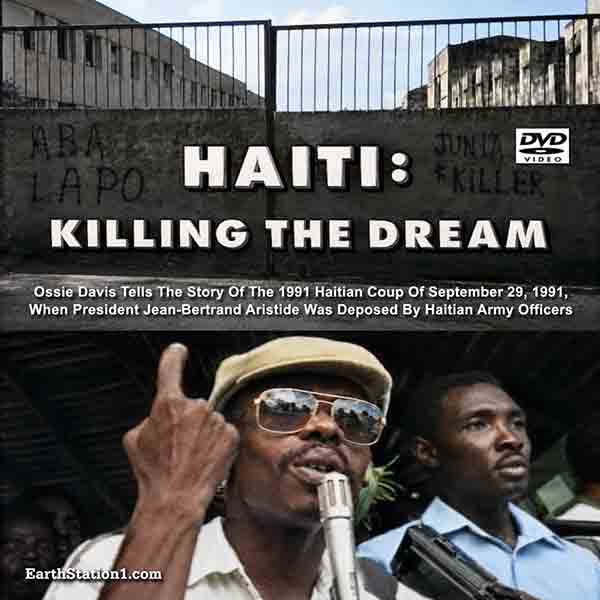
August 21, 1791: The Age Of Enlightenment
(The Enlightenment, The Age Of Reason): The Age Of Revolution: The
Atlantic Revolutions: The French Revolution: The French
Revolutionary And Napoleonic Wars (The Great French War) (The
French Revolutionary Wars, The Napoleonic Wars): Slavery: The
Atlantic Slave Trade: Slavery In Haiti And Santo Domingo
(1625-1789): Abolitionism: The Haitian Revolution (French:
Revolution Haitienne) (The War Of Independence (French: La Guerre
De L'Independance) [Haitian Creole: Lage D Lendependans]): The
1791 Slave Rebellion: -- A slave violent rebellion in the French
colony of Saint-Domingue sparks The Haitian Revolution, the
successful insurrection by enslaved Africans against French
colonial rule in Saint-Domingue (modern Haiti) when a nightime
Vodou ceremony, held in Bois Caiman forest behind the Choiseul
Plantation and led by voodoo priest Dutty Boukman and priestess
Cecile Fatiman, hears them prophecy that the Haitian Revolution
was to take place, led by Georges Biassou, Jeannot, and
Jean-Francois Papillon .Unlike previous rebellions, French
colonial authorities were unable to suppress it, and the rebellion
eventually led to the abolition of slavery in the colony. The
revolt was notable for being one of the only slave rebellions in
history to succeed and for its prominence in the history of Haiti.
By the time of the rebellion, over half the population of
Saint-Domingue was enslaved. The outbreak of the French Revolution
and subsequent signing of the Declaration of the Rights of Man and
of the Citizen, which were based upon the idea of liberty,
equality, and fraternity for all men, sparked tension in the
colony as abolitionists and enslaved people became more radical
while the ruling class attempted to tighten its grip on power.
Following years of bloody fighting, the independence of Haiti was
secured in 1804. On Sale Until Midnight Tonight PT!
https://store.earthstation1.com/haiti-killing-the-dream-the-1991-haitian-coup-dvd-download1991.html
Today's
EarthStation1.com 15% (Or More!) Off Commemorative Memorial Title:
The American Adventure: TV History Series 1607-1876 DVD MP4 USB
Drive
Today, August 21, 2026
August 21-23, 1831: Slavery: Slavery In
The United States: Slave Rebellions: Slave Rebellions In The
United States: Nat Turner's Slave Rebellion (The Southampton
Insurrection): -- African American slave Nat Turner leads a slave
rebellion in Southampton County, Virginia occurs where rebel
slaves kill between 55 to 65 people, at least 51 being white. The
rebellion was put down within a few days, but Turner survived in
hiding for more than two months afterwards. The rebellion was
effectively suppressed at Belmont Plantation on the morning of
August 23, 1831. There was widespread fear in the aftermath, and
white militias organized in retaliation against the slaves. The
state executed 56 slaves accused of being part of the rebellion,
and many non-participant slaves were punished in the frenzy.
Approximately 120 slaves and free blacks were murdered by militias
and mobs in the area. Approximately 250 blacks in total died as a
result of the rebellion. State legislatures passed new laws
prohibiting education of slaves and free black people, restricting
rights of assembly and other civil liberties for free black
people, and requiring white ministers to be present at all worship
services. On Sale Until Midnight Tonight PT!
https://store.earthstation1.com/the-american-adventure-series-us-1st-century-4-dv14.html
Today's
EarthStation1.com 15% (Or More!) Off Commemorative Memorial Title:
Pursuit To The Rhine The Liberation Of Western Europe MP4 Download
DVD
Today, August 21, 2026
August 21, 1944: Operation Overlord (The
Battle Of Normandy, The Normandy Campaign): D-Day (The D-Day
Landings, The Normandy Landings): The Battle Of The Falaise Pocket
(The Falaise Pocket, Operation Tractable) (German: Kessel Von
Falaise, "The Falaise Cauldron"): -- Canadian and Polish
units, supported by one brigade of British tanks, capture the
strategically important town of Falaise, Calvados, France. Code
named Operation Tractable, it was the final offensive component of
the Battle of Normandy during World War II. The goal of this
operation was to capture Falaise and then the smaller towns of
Trun and Chambois. This operation was part of the largest
encirclement on the Western Front during the Second World War.
Despite a slow start and limited gains north of Falaise, novel
tactics by the 1st Polish Armoured Division: under the command of
General brygady Stanislaw Maczek during the drive for Chambois:
enabled the Falaise Gap to be partially closed by 19 August 1944,
trapping about 150,000 German soldiers in the Falaise Pocket.
Although the Falaise Gap was narrowed to a distance of several
hundred metres (yards), attacks and counter-attacks by two battle
groups of the 1st Polish Armoured Division and the II SS Panzer
Corps on Hill 262 (Mont Ormel) prevented the quick closing of the
gap and thousands of German troops escaped. During two days of
nearly continuous fighting, Polish forces using artillery barrages
and close-quarter fighting, managed to hold off counter-attacks by
seven German divisions. On August 21, elements of the First
Canadian Army relieved the Polish survivors and sealed the Falaise
Pocket by linking up with the Third US Army. This led to the
surrender and capture of the remaining units of the German 7th
Army in the pocket. On Sale Until Midnight Tonight PT!
https://store.earthstation1.com/pursuit-to-the-rhine-the-liberation-of-western-europe-mp4-download-dv4.html
Today's
EarthStation1.com 15% (Or More!) Off Commemorative Memorial Title:
Vietnam: The Ten Thousand Day War TV Series DVD, Video Download,
USB
Today, August 21, 2026
August 21, 1963: The Aftermath Of World
War II: The Cold War: The Cold War In Asia: The Indochina Wars:
The Vietnam War (The Second Indochina War, The Vietnam Conflict,
The Resistance War Against America): The United States In The
Vietnam War: Protests In Vietnam: The Buddhist Crisis
(May-November, 1963) (Vietnamese: Bien Co Phat Giao): The Xa Loi
Pagoda Raids (Vietnamese Pronunciation: SAH-loy): -- The Army of
the Republic of Vietnam Special Forces loyal to Ngo Dinh Nhu,
brother of President Ngo Dinh Diem, vandalizes Buddhist pagodas
across the country, arresting thousands and leaving an estimated
hundreds dead. The Xa Loi Pagoda raids were a series of
synchronized attacks on various Buddhist pagodas in the major
cities of South Vietnam shortly. The raids were executed by the
Army of the Republic of Vietnam Special Forces under Colonel Le
Quang Tung, and combat police, both of which took their orders
directly from Ngo Dinh Nhu, younger brother of the Roman Catholic
President Ngo Dinh Diem. Xa Loi Pagoda, the largest pagoda in the
South Vietnamese capital, Saigon, was the most prominent of the
raided temples. Over 1,400 Buddhists were arrested, and estimates
of the death toll and missing ranged up to the hundreds. In
response to the Hue Vesak shootings and a ban on the Buddhist flag
in early May, South Vietnam's Buddhist majority rose in widespread
civil disobedience and protest against the religious bias and
discrimination of the Catholic-dominated Diem government. Buddhist
temples in major cities, most prominently the Xa Loi pagoda,
became focal points for protesters and assembly points for
Buddhist monks from rural areas. In August, several Army of the
Republic of Vietnam (ARVN) generals proposed the imposition of
martial law, ostensibly to break up the demonstrations, but in
reality to prepare for a military coup. However, Nhu, already
looking to arrest Buddhist leaders and crush the protest movement,
used the opportunity to preempt the generals and embarrass them.
He disguised Tung's Special Forces in army uniforms and used them
to attack the Buddhists, thereby causing the general public and
South Vietnam's U.S. allies to blame the army, diminishing the
generals' reputations and ability to act as future national
leaders. Soon after midnight, Nhu's men attacked the pagodas using
automatic firearms, grenades, battering rams and explosives,
causing widespread damage. Some religious objects were destroyed,
including a statue of Gautama Buddha in the Tu Dam Pagoda in Hue,
which was partially leveled by explosives. Temples were looted and
vandalized, with the remains of venerated monks confiscated. In
Hue, violent street battles erupted between government forces and
rioting pro-Buddhist, anti-government civilians. Initially, the
Ngo family claimed that the army had carried out the raids,
something their U.S. allies initially believed. However, this was
later debunked, and the incident prompted the United States to
turn against the regime and begin exploring alternative leadership
options, eventually leading to Diem's overthrow in a coup. In
South Vietnam itself, the raids stoked widespread anger. Several
high-ranking public servants resigned, and university and high
school students boycotted classes and staged riotous
demonstrations, resulting in further mass incarcerations. As most
of the students were from middle-class public service and military
families, the arrests caused further upset among the Ngo family's
power base. On Sale Until Midnight Tonight PT!
https://store.earthstation1.com/vietnam-the-10000-day-war-4-dual-layer-dvds-all-13-10000413.html
Today's
EarthStation1.com 15% (Or More!) Off Commemorative Memorial Title:
Czechoslovakia: The Long Wait For Revolution DVD, Download, USB
Drive
Today, August 21, 2026
August 20-21, 1968: The Aftermath Of
World War II: The Cold War: The Cold War (1962-1979): The Era Of
Stagnation (1964-1982): Counterculture Of The 1960s: The Protests
Of 1968: The Prague Spring: The Warsaw Pact Invasion Of
Czechoslovakia: -- Soviet Union-dominated Warsaw Pact troops
invade Czechoslovakia, crushing the Prague Spring; only Albania
and Romania refuse to participate. The Warsaw Pact Invasion Of
Czechoslovakia, officially known as Operation Danube, was a joint
invasion of Czechoslovakia by five Warsaw Pact countries - the
Soviet Union, Bulgaria, Hungary, East Germany and Poland - on the
night of August 20-21, 1968. Approximately 250,000 Warsaw pact
troops attacked Czechoslovakia that night, with Romania and
Albania refusing to participate. East German forces, except for a
small number of specialists, did not participate in the invasion
because they were ordered from Moscow not to cross the
Czechoslovak border just hours before the invasion. 137
Czechoslovakian civilians were killed and 500 seriously wounded
during the occupation. The invasion successfully stopped Alexander
Dubcek's Prague Spring liberalisation reforms and strengthened the
authority of the authoritarian wing within the Communist Party of
Czechoslovakia (KSC). The foreign policy of the Soviet Union
during this era was known as the Brezhnev Doctrine. The Prague
Spring (Czech: Prazske Jaro, Slovak: Prazska Jar) was a period of
political liberalization in Czechoslovakia during the era of its
domination by the Soviet Union after World War II. It began on 5
January 1968, when reformist Alexander Dubcek was elected First
Secretary of the Communist Party of Czechoslovakia (KSC), and
continued until August 21, 1968 when the Soviet Union and other
members of the Warsaw Pact invaded the country to halt the
reforms. The Prague Spring reforms were a strong attempt by Dubcek
to grant additional rights to the citizens of Czechoslovakia in an
act of partial decentralization of the economy and
democratization. The freedoms granted included a loosening of
restrictions on the media, speech and travel. After national
discussion of dividing the country into a federation of three
republics, Bohemia, Moravia-Silesia and Slovakia, Dubcek oversaw
the decision to split into two, the Czech Republic and Slovak
Republic. This was the only formal change that survived the end of
Prague Spring, though the relative success of the nonviolent
resistance undoubtedly prefigured and facilitated the peaceful
transition to liberal democracy with the collapse of Soviet
hegemony in 1989. The reforms, especially the decentralization of
administrative authority, were not received well by the Soviets,
who, after failed negotiations, sent half a million Warsaw Pact
troops and tanks to occupy the country. The New York Times cited
reports of 650,000 men equipped with the most modern and
sophisticated weapons in the Soviet military catalogue. A large
wave of emigration swept the nation. A spirited non-violent
resistance was mounted throughout the country, involving attempted
fraternization, painting over and turning street signs (on one
occasion an entire invasion force from Poland was routed back out
of the country after a day's wandering), defiance of various
curfews, etc. While the Soviet military had predicted that it
would take four days to subdue the country, the resistance held
out for eight months and was only circumvented by diplomatic
stratagems. There were sporadic acts of violence and several
suicides by self-immolation (such as that of Jan Palach), but
there was no military resistance. Czechoslovakia remained
Soviet-controlled until 1989, when the Velvet Revolution ended
pro-Soviet rule peacefully, undoubtedly drawing upon the successes
of the non-violent resistance twenty years earlier. The resistance
also became an iconic example of civilian-based defense which,
along with unarmed civilian peacekeeping, constitute the two ways
that nonviolence can be and occasionally has been applied directly
to military or paramilitary threats. After the invasion,
Czechoslovakia entered a period known as "normalization":
subsequent leaders attempted to restore the political and economic
values that had prevailed before Dubcek gained control of the KSC.
Gustav Husak, who replaced Dubcek and also became President,
reversed almost all of Dubcek's reforms. The Prague Spring
inspired music and literature such as the work of Vaclav Havel,
Karel Husa, Karel Kryl and Milan Kundera's novel The Unbearable
Lightness of Being. On Sale Until Midnight Tonight PT!
https://store.earthstation1.com/czechoslovakia-the-long-wait-for-spring-dvd-1988-cold1988.html
Today's
EarthStation1.com 15% (Or More!) Off Commemorative Memorial Title:
The Second Russian Revolution TV Series DVD, Video Download, USB
Drive
Today, August 21, 2026
August 21, 1991: The Aftermath Of World
War II: The Cold War: The Cold War (1985-1991) (The End Of The
Cold War): The Dissolution Of The Soviet Union: The Revolutions Of
1989 (The Fall Of Nations, The Autumn Of Nations, The Fall Of
Communism): The Eastern Bloc (The Communist Bloc, The Socialist
Bloc, The Soviet Bloc): Russia: The History Of Russia: The 1991
Soviet Coup D'Etat Attempt (Russian: Popytka Sovetskogo
Gosudarstvennogo Perevorota 1991 Goda) (The 1991 Soviet Coup
[Russian: Sovetskiy Perevorot 1991 Goda], The August Coup
[Avgustovskiy Perevorot], The Kremlin Coup [Kremlevskiy
Perevorot]): -- The coup against Mikhail Gorbachev collapses. The
Republic of Latvia declares its sovereignty officially completed
with a law passed by its deputies. The 1991 Soviet Coup D'Etat
Attempt occured between August 19 and August 22, 1991. At about
1:00, not far from the White House, trolleybuses and street
cleaning machines barricaded a tunnel against oncoming Taman
Guards infantry fighting vehicles (IFVs). Three men were killed in
the incident, Dmitry Komar, Vladimir Usov, and Ilya Krichevsky,
while several others were wounded. Komar, a 22 year old veteran
from the Soviet invasion of Afghanistan, was shot and crushed
trying to cover a moving IFV's observation slit. Usov, a 37 year
old economist, was killed by a stray bullet whilst coming to
Komar's aid. The crowd set fire to an IFV and Krichevsky, a 28
year old architect, was shot dead as the troops escaped. According
to Sergey Parkhomenko, a journalist and democracy campaigner who
was in the crowd defending the White House, "Those deaths
played a crucial role: Both sides were so horrified that it
brought a halt to everything." Alpha Group and Vympel did not
move to the White House as had been planned and Yazov ordered the
troops to pull out from Moscow. The troops began to move from
Moscow at 8:00. The GKChP members met in the Defence Ministry and,
not knowing what to do, decided to send Kryuchkov, Yazov,
Baklanov, Tizyakov, Anatoly Lukyanov, and Deputy CPSU General
Secretary Vladimir Ivashko to Crimea to meet Gorbachev, who
refused to meet them when they arrived. With the dacha's
communications to Moscow restored, Gorbachev declared all the
GKChP's decisions void and dismissed its members from their state
offices. The USSR General Prosecutors Office started the
investigation of the coup. During that period, the Supreme Council
of the Republic of Latvia declared its sovereignty officially
completed with a law passed by its deputies, confirming the
independence restoration act of 4 May as an official act. In
Tallinn, just a day after the resitution of independence, the
Tallinn TV Tower was taken over by the Airborne Troops, while the
television broadcast was cut off for a while, the radio signal was
strong as a handful of Estonian Defence League (the unified
paramilitary armed forces of Estonia) members barricaded the entry
into signal rooms. In the evening, as news of the failure of the
coup reached the republic, the paratroopers departed from the
tower and left the capital. On Sale Until Midnight Tonight PT!
https://store.earthstation1.com/the-second-russian-revolution-6-dvd-set-complete-tv-serie6.html
Today's
EarthStation1.com 15% (Or More!) Off Commemorative Memorial Title:
World War II: The War Years 17 Part TV Series MP4 Video Download
DVD
Today, August 21, 2026
August 21, 1944: The European Civil War:
World War II: The Diplomatic History Of World War II: World War II
Conferences: The Dumbarton Oaks Conference (The Washington
Conversations On International Peace And Security Organization)
(August 21, 1944 - October 7, 1944): -- The Dumbarton Oaks
Conference begins, an international conference led by "The
Four Policemen", a postwar council with the Big Four that US
President Franklin Roosevelt proposed as a guarantor of world
peace, meet at The Dumbarton Oaks estate in the Georgetown
neighborhood of Washington, D.C. to formulate and negotiate
proposals for the establishment of a "general international
organization", which was later to become the United Nations.
Roosevelt repeatedly used the phrase "The Four Policemen"
starting in 1942 in reference to what were called the Four Powers
during World War II and were in fact the four major Allies of
World War II: the United Kingdom, the United States, the Soviet
Union, and China. The Dumbarton Oaks Conference constituted the
first important step taken to carry out paragraph 4 of the Moscow
Declaration of 1943, which recognized the need for a postwar
international organization to succeed the League of Nations. On
Sale Until Midnight Tonight PT!
https://store.earthstation1.com/world-war-ii-the-war-years-17-part-tv-series-mp4-video-download-174.html
Today's
EarthStation1.com 15% (Or More!) Off Commemorative Memorial Title:
The Guns Of August (1964) WWI Film DVD, Video Download, USB Drive
Today, August 21, 2026
August 21, 1914: The European Civil War:
World War I: The First European War (The European Theater Of World
War I): The Guns Of August: The Western Front Of World War I: The
Battle Of The Frontiers: The Battle Of Charleroi (The Battle Of
The Sambre) (French: Bataille de Charleroi): -- A successful
attack by the the German 2nd and 3rd armies across the River
Sambre pre-empts a French offensive by the French Fifth Army in
the same area, beginning The Batle Of Charleroi, fought during The
Battle Of The Frontiers. The French were planning an attack across
the Sambre River; when the Germans attacked first, the French were
forced back from the river and nearly cut off the French retreat
by crossing the Meuse around Dinant and getting behind the French
right flank. The French were saved by a counter-attack at Dinant
and the re-direction of the 3rd Army to the north-west in support
of the 2nd Army, rather than south-west. Battle Of Charleroi was
the first of a pair of Allied defeats that precipitated what
became known The Great Retreat, (French: La Grande Retraite) also
known as the Retreat From Mons, a long withdrawal to the River
Marne, in August and September 1914, by the British Expeditionary
Force (BEF) and the French Fifth Army, after their defeats by the
Imperial German armies at the Battle Of Charleroi (August 21) and
The Battle Of Mons (August 23). On Sale Until Midnight Tonight PT!
https://store.earthstation1.com/the-guns-of-august-dvd-1964-world-war-i-movie-documen1964.html
Today's
EarthStation1.com 15% (Or More!) Off Commemorative Memorial Title:
Jesse James & The James-Younger Gang DVD MP4 Download USB
Flash Drive
Today, August 21, 2026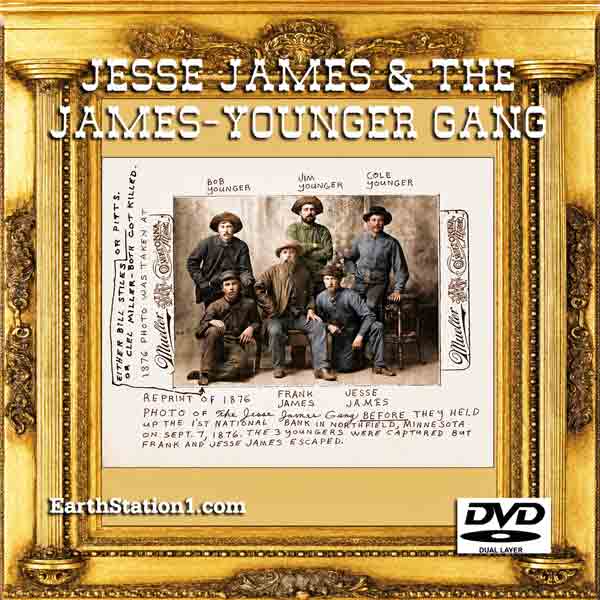
August 21, 1863: The American Civil War
(The Civil War, The War Between The States): Naval Warfare Of The
American Civil War (Naval Battles Of The American Civil War): The
Trans-Mississippi Theater Of The American Civil War: The Lawrence
Massacre: (Quantrill's Raid): -- On a Friday morning, William
Quantrill leads 450 irregular Confederate raiders on a pre-dawn
terrorist raid of the Unionist town of Lawrence, Kansas, leaving
150 civilian men and boys dead, 30 wounded and much of the town a
smoking ruin. The Lawrence Massacre, also known as Quantrill's
Raid, was wrought up on Lawrence due to the town's long support of
abolition, and its reputation as a center for the Jayhawkers, who
were free-state militia and vigilante groups known for attacking
plantations in pro-slavery Missouri's western counties. Early in
the war, Missouri and Kansas were nominally under Union government
control and became subject to widespread violence as groups of
Confederate partisan guerrillas (also known as "bushwhackers")
and anti-slavery Jayhawkers competed for control. The town of
Lawrence, Kansas, a center of anti-slavery sentiment, had outlawed
Quantrill's men and jailed some of their young women. In August
1863, Quantrill led an attack on the town, killing more than 180
civilians, supposedly in retaliation for the casualties caused
when the women's jail had collapsed. Quantrill's Raiders were the
best-known of the pro-Confederate bushwhackers. They included
Jesse James and his brother Frank, who used the tactics learned
from Quantrill when they formed the James-Younger gang and
conducted robberies for years as a continuing insurgency in the
region. The Confederate government, which had granted Quantrill a
field commission under the Partisan Ranger Act, was outraged and
withdrew support for such irregular forces; in 1862, Quantrill had
been initially been denied a Confederate commission by Confederate
Secretary of War LeRoy Pope Walker, who labeled Quantrill's
notions of war as "barbarism.". By 1864 Quantrill had
lost control of the group, which split up into small bands. Some,
including Quantrill, were killed in various engagements. Others
lived on to hold reunions many years later, when the name
Quantrill's Raiders began to be used. On Sale Until Midnight
Tonight PT!
https://store.earthstation1.com/jesse-james-amp-the-jamesyounger-gang-dvd-mp4-download-usb-flash-driv4.html
Today's
EarthStation1.com 15% (Or More!) Off Commemorative Memorial Title:
Rhythm And Blues Revue (1955) DVD, MP4 Video Download, USB Flash
Drive
Today, August 21, 2026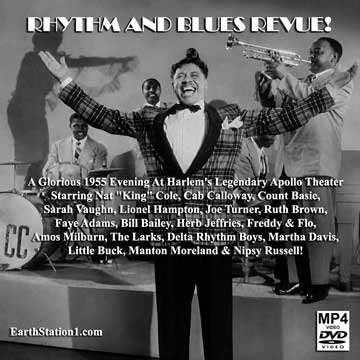
August 21, 1904: #BOTD: #HBD! Count
Basie, African American jazz pianist, organist, composer, and
bandleader (d. April 26, 1984) is #born William James Basie in Red
Bank, New Jersey. Dropping out of school, Count Basie (so named
because he was considered by his early peers a fourth-string
musician; first string musicans were called "one count",
etc.; fourth string was called "no count", so Casie
coopted and transformed the name into "count") learned
to improvise accompaniment for silent films at a local movie
theater in his home town of Red Bank, New Jersey. In 1924, he went
to Harlem, where his performing career expanded; he toured with
groups to the major jazz cities of Chicago, St. Louis and Kansas
City. In 1929 he joined Bennie Moten' band in Kansas City, and
played with them until Moten' death in 1935. In 1935, Basie formed
the Count Basie Orchestra, and in 1936 took them to Chicago for a
long engagement and their first recording. He created innovations
like the use of two "split" tenor saxophones,
emphasizing the rhythm section, riffing with a big band, using
arrangers to broaden their sound, and others. Many musicians came
to prominence under his direction, including the tenor
saxophonists Lester Young and Herschel Evans, the guitarist
Freddie Green, trumpeters Buck Clayton and Harry "Sweets"
Edison and singers Jimmy Rushing and Joe Williams. Count Basie
died of pancreatic cancer in Hollywood, Florida at the age of 79.
He is buried at Pinelawn Memorial Park And Arboretum, East
Farmingdale, New York. On Sale Until Midnight Tonight PT!
https://store.earthstation1.com/rhythm-and-blues-revue-dvd-1955-apollo-theater-tv-1955.html
Today's
EarthStation1.com 15% (Or More!) Off Commemorative Memorial Title:
Alternative Sgt. Pepper's Lonely Hearts Club Band MP3 CD Download
USB
Today, August 21, 2026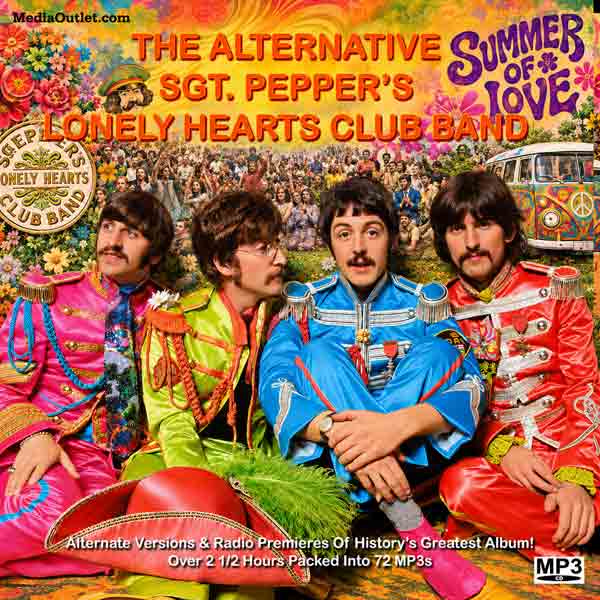
August 21, 1872: #BOTD: #HBD!: Aubrey
Beardsley, English illustrator and author, leading figure in the
aesthetic movement which also included Oscar Wilde and James
McNeill Whistler whose contribution to the development of the Art
Nouveau and poster styles was significant despite his early death
(d. March 16, 1898) is #born Aubrey Vincent Beardsley in Brighton,
Sussex, England. His black ink drawings were influenced by
Japanese woodcuts, and depicted the grotesque, the decadent, and
the erotic. He is one of the important Modern Style figures, a
style of architecture, art, and design that first emerged in the
United Kingdom in the mid-1880s that was the first Art Nouveau
style worldwide and represents the evolution of the Arts and
Crafts movement which was native to Great Britain. Aubrey
Beardsley's black ink drawings were influenced by Japanese
woodcuts, and emphasized the grotesque, the decadent, and the
erotic. He was a leading figure in the aesthetic movement which
also included Oscar Wilde and James McNeill Whistler. Beardsley's
contribution to the development of the Art Nouveau and poster
styles was significant despite his early death. He is featured on
the cover of The Beatles album cover of Sgt. Pepper's Lonely
Hearts Club Band, and the cover of their Revolver album, designed
by Klaus Voormann, combined Aubrey Beardsley-inspired line drawing
with photo collage and won the 1967 Grammy Award for Best Album
Cover, Graphic Arts. Aubrey Beardsley died at the age of 25 of
tuberculosis at the Cosmopolitan Hotel in Menton, Alpes-Maritimes,
France, attended by his mother and sister. Following a requiem
mass in Menton Cathedral the following day, his remains were
interred in the Cimetiere du Trabuquet. On Sale Until Midnight
Tonight PT!
https://store.earthstation1.com/alternative-sgt-pepper39s-lonely-hearts-club-band-mp3-cd-download-393.html
Today's
EarthStation1.com 15% (Or More!) Off Commemorative Memorial Title:
WABC Radio Airchecks MP3 Collection 1960s-1980s DVD, MP3 Download,
USB
Today, August 21, 2026
August 21, 1961: Aesthetics: The
Performing Arts: Music: Music History: Music Of The United States:
The History Of Rock And Roll (Rock & Roll, Rock-N-Roll, Rock
'N' Roll, Rock 'N Roll, Rock N' Roll): The History Of Motown: The
History Of Girl Groups (The History Of Gurl Groups): The
Marvelettes: Record Releases: -- Motown releases what would become
its first #1 hit on the Billboard Hot 100 pop singles chart,
"Please Mr. Postman" by The Marvelettes; it hit number
one on the R & B chart as well. "Please Mr. Postman"
is a song written by Georgia Dobbins, William Garrett, Freddie
Gorman, Brian Holland, and Robert Bateman. It is the debut single
by the Marvelettes for the Tamla (Motown) label. "Please Mr.
Postman" became a number-one hit again in early 1975 when the
Carpenters' cover of the song reached the top position of the
Billboard Hot 100. "Please Mr. Postman" has been covered
several times, including by the British rock group The Beatles in
1963. On Sale Until Midnight Tonight PT!
https://store.earthstation1.com/wabc-musicradio-shows-mp3-dvd-60s80s-am-360807775.html
Today's
EarthStation1.com 15% (Or More!) Off Commemorative Memorial Title:
Rock & Roll An Unruly History 10 Part TV Series MP4 Video
Download DVD
Today, August 21, 2026
August 21, 1952: #BOTD: #HBD! Joe
Strummer, English singer, songwriter, composer, actor and
guitarist, co-founder, lyricist, rhythm guitarist and co-lead
vocalist of The Clash, a rock band formed in 1976 as part of the
original wave of British punk rock (d. December 22, 2002) is #born
John Graham Mellor in Ankara, Turkey. The Clash's second album,
Give 'Em Enough Rope (1978) reached number 2 on the UK charts.
Soon after, they achieved success in the US, starting with London
Calling (1979), and peaking with 1982's Combat Rock, reaching
number 7 on the US charts and being certified 2x platinum there.
The Clash's explosive political lyrics, eclectic musical
experimentation, and rebellious attitude had a far-reaching
influence on rock music in general, and alternative rock in
particular. Their music incorporated reggae, ska, dub, funk, rap,
and rockabilly. Strummer's career included stints with the 101ers,
Latino Rockabilly War, the Mescaleros, and the Pogues, in addition
to his own solo music. His work as a musician allowed him to
explore other interests, including acting, creating film scores
for television and movies, songwriting, radio broadcasting, and as
a radio host on the BBC Radio show London Calling. Strummer and
the Clash were inducted into the Rock and Roll Hall of Fame in
January 2003. Joe Strummer died in Broomfield, Somerset, England
at age 50, found dead by his wife Lucinda Tait at his home in
Broomfield, Somerset. An autopsy showed that he died from a heart
attack caused by an undiagnosed congenital heart defect. His
estate was valued at just under 1M USD, and he left all the money
to his wife. Strummer was cremated, and his ashes were given to
his family. In his remembrance, Strummer's friends and family
established the Joe Strummer Foundation (initially known as
Strummerville), a non-profit organisation which gives
opportunities to musicians and support to projects around the
world that create empowerment through music. On Sale Until
Midnight Tonight PT!
https://store.earthstation1.com/rock-amp-roll-an-unruly-history-10-part-tv-series-mp4-video-download-104.html
Today's
EarthStation1.com 15% (Or More!) Off Commemorative Memorial Title:
The Fabulous Sixties with Peter Jennings TV Docuseries MP4 Or DVD
Set
Today, August 21, 2026
August 21, 1936: #BOTD: #HBD! Wilt
Chamberlain, African American professional basketball player who
played as a center, basketball coach, businessman, author and
actor (d. October 12, 1999) is #born Wilton Norman Chamberlain in
Philadelphia, Pennsylvania, into a family of nine children, the
son of Olivia Ruth Johnson, a domestic worker and homemaker, and
William Chamberlain, a welder, custodian, and handyman. He was a
frail child, nearly dying of pneumonia in his early years and
missing a whole year of school as a result.In his early years,
Chamberlain was not interested in basketball because he thought it
was "a game for sissies". Standing at 7 ft 1 in tall, he
played in the National Basketball Association (NBA) for 14 years,
and is widely regarded as one of the greatest players in the
sport's history. Several publications have argued that Chamberlain
is the greatest NBA player of all time. He holds numerous NBA
regular season records in scoring, rebounding, and durability
categories; most notably he is the only player to score 100 points
in a single NBA game, and average more than 40 and 50 points in a
season. Further records that Chamberlain achieved include being
the only player in NBA history to average at least 30 points and
20 rebounds per game in a season, a feat he accomplished seven
times, and the only player to average at least 30 points and 20
rebounds per game over the entire course of his NBA career.
Chamberlain played for the Kansas Jayhawks and the Harlem
Globetrotters before joining the NBA, where he played for the
Philadelphia / San Francisco Warriors, the Philadelphia 76ers, and
the Los Angeles Lakers. During his time in the NBA, Chamberlain
enjoyed an on-court rivalry with Boston Celtics' Bill Russell.
Although Chamberlain suffered a long string of NBA Finals losses
during his career, he had a successful career, winning two NBA
championships, earning four regular-season NBA Most Valuable
Player (MVP) awards, the NBA Rookie of the Year award, one NBA
Finals MVP award, and one NBA All-Star Game MVP award, and he was
selected to thirteen NBA All-Star Games and ten All-NBA Teams
(seven First and three Second teams). He won seven scoring, eleven
rebounding, nine durability, and nine field goal percentage
titles, and he led the league in assists once. He was enshrined in
the Naismith Memorial Basketball Hall of Fame in 1978, elected
into the NBA 35th Anniversary Team in 1980, chosen as one of the
50 Greatest Players in NBA History in 1996, and in 2021 was named
to the NBA 75th Anniversary Team. Chamberlain was known by several
nicknames during his basketball playing career. He disliked the
ones that called attention to his height, such as "Goliath"
and "Wilt the Stilt". A Philadelphia sportswriter coined
the nicknames during Chamberlain's high school days. He preferred
"The Big Dipper", which was inspired by his friends who
saw him dip his head as he walked through doorways. After his
professional basketball career ended, Chamberlain played
volleyball in the short-lived International Volleyball Association
(IVA), was president of the IVA, and is enshrined in the IVA Hall
of Fame for his contributions. He was a successful businessman,
authored several books, and appeared in the 1984 movie Conan the
Destroyer. Chamberlain was also a lifelong bachelor and became
notorious for his statement of having had sexual relations with as
many as 20,000 women. Chamberlain, who had a history of
cardiovascular disease , died of congestive heart failure in Los
Angeles, California, aged 63. A memorial service for Chamberlain
was held at the City of Angels Church of Religious Science in Los
Angeles on October 16, 1999. A second memorial service was held at
his home church, Mount Carmel Baptist Church, in Philadelphia on
October 21, 1999. He remains were cremated, and the ashes were
given to family members. On Sale Until Midnight Tonight PT!
https://store.earthstation1.com/decades-the-1960s-dvd-set-peter-jennings-tv-series-3-19603.html
Today's
EarthStation1.com 15% (Or More!) Off Commemorative Memorial Title:
Fear On Trial - John Henry Faulk DVD, Video Download, USB Flash
Drive
Today, August 21, 2026
August 21, 1913: #BOTD: #HBD! John Henry
Faulk, popular storyteller, folklorist, soldier, actor and CBS
radio show host, whose successful lawsuit against the
entertainment industry helped to bring an end to the Hollywood
blacklist during the Second Red Scare of the 1950s (d. April 9,
1990) is #born in Austin, Texas to Methodist parents Henry Faulk
and his wife Martha Miner Faulk. John Henry had four siblings.
Faulk spent his childhood years in Austin in the noted Victorian
house Green Pastures.Charles McClure, a journalist acquaintance of
Faulk from Austin wrote that the two of them came from "extremely
similar family backgrounds - the old Southern wealth with rich
heritage and families dedicated to civil rights long before it was
hip to fight racism." Faulk enrolled at the University of
Texas in Austin in 1932. He became a protege of J. Frank Dobie,
Walter Prescott Webb, Roy Bedichek, and Mody C. Boatright,
enabling Faulk to hone his skills as a folklorist. He earned a
master's degree in folklore with his thesis "Ten Negro
Sermons". He further began to craft his oratory style as a
part-time English teacher at the university 1940-1942, relating
Texas folk tales peppered with his gift of character
impersonations. He was initially unfit for service with the United
States Army because of an eye problem. Instead Faulk joined the
Merchant Marine in 1942 for a one-year stint, spending 1943 in
Cairo, Egypt, serving the American Red Cross. World War II had
caused the United States Army to relax its enlistment standards,
and Faulk finally enlisted in 1944. He served as a medic at Camp
Swift, Texas. It was during this period Faulk also joined the
American Civil Liberties Union. While a soldier at Camp Swift,
Faulk began writing his own radio scripts. An acquaintance
facilitated an interview for him at WCBS in New York City. The
network executives were sufficiently impressed to offer him his
own radio show. Upon his 1946 discharge from the Army, Faulk began
his Johnny's Front Porch radio show for WCBS. The show featured
Faulk's characterizations that he had been developing since his
university years. Faulk eventually went to another radio station,
but returned to WCBS for a four-hour morning talk show. The John
Henry Faulk Show ran for six years. His radio successes provided
opportunity for him to appear as himself on television, in shows
like the 1951 Mark Goodson and William Todman game show It's News
to Me, hosted by John Charles Daly. He also appeared on Leave It
to the Girls in 1953 and The Name's the Same in 1955. Cactus Pryor
met Faulk in the studios of KLBJ (then KTBC) where Faulk stopped
by to thank Pryor for letting his mother hear his New York show.
Pryor had been "accidentally" broadcasting Faulk's radio
show in Texas where Faulk was not otherwise heard. Although the
broadcast happened repeatedly, Pryor always claimed he just hit
the wrong button in the studio. Pryor visited Faulk at a Manhattan
apartment he shared with Alan Lomax and became introduced to the
movers and shakers of the east coast celebrity scene of that era.
When Pryor stood by Faulk during the blacklisting and tried to
find him work, Pryor's children were harassed, a prominent Austin
physician circulated a letter questioning Pryor's patriotism, and
an Austin attorney tried to convince Lyndon B. Johnson to
discharge Pryor from the airwaves. The Pryor family and the Faulk
family remained close and supportive of each other for the rest of
Faulk's life. In December 1955, Faulk was elected second vice
president of the American Federation of Television and Radio
Artists. Orson Bean was the first vice president and Charles
Collingwood was the president of the union. Collingwood, Bean and
Faulk were part of a middle-of-the-road slate of non-communist,
anti-AWARE organization candidates that Faulk had helped draft.
Twenty-seven of thirty-five vacant seats on the board went to the
middle-of-the-road slate. Faulk's public position during the
campaign had been that the union should be focused on jobs and
security, not blacklisting of members. In the 1970s in Austin, he
was also befriended by the young co-editor of the Texas Observer,
Molly Ivins, and became an early supporter of hers. Faulk's radio
career at CBS ended in 1957, a victim of the Cold War and the
blacklisting of the 1950s. AWARE, Inc., a for-profit corporation
inspired by Wisconsin Senator Joseph McCarthy, published "Red
Channels: The Report of Communist Influence in Radio and
Television", an anti-Communist pamphlet-style book issued by
the right-wing journal "Counterattack", itself weekly,
subscription-based, anti-communist, mimeographed newsletter
operated from 1947 into the 1950s by a "private, independent
organization" started by three ex-FBI agents. On June 22,
1950, Red Channels named 151 actors, writers, musicians, broadcast
journalists, and others in the context of purported Communist
manipulation of the entertainment industry. Some of the 151 were
already being denied employment because of their political
beliefs, history, or association with suspected subversives. Red
Channels effectively placed the rest on the industry blacklist.
AWARE offered a "clearance" service to major media
advertisers and radio and television networks; for a fee, AWARE
would investigate the backgrounds of entertainers for signs of
Communist sympathy or affiliation. In 1955, Faulk earned the ill
will of the blacklisting organization when he and other members
wrested control of their union, the American Federation of
Television and Radio Artists from officers backed by AWARE. In
reprisal, AWARE labeled Faulk a Communist. When he discovered that
AWARE was actively keeping radio stations from offering him
employment, Faulk sought compensation. Several prominent radio
personalities along with CBS News vice president Edward R. Murrow
supported Faulk's attempt to put an end to blacklisting. With
financial backing from Faulk's friends Murrow, Parks Johnson (a
Wimberley native who was known as "Pop Vox" during the
1930s-40s in his New York radio show, creator of the "man on
the street" interview, known as "the voice of the U.S.
military during World War II"), and Walter Cronkite, Faulk
engaged New York attorney Louis Nizer. Attorneys for AWARE,
including McCarthy-committee counsel Roy Cohn, managed to stall
the suit, originally filed in 1957, for five years. When the trial
finally concluded in a New York courtroom, the jury had determined
that Faulk should receive more compensation than he sought in his
original petition. On June 28, 1962, the jury awarded him the
largest libel judgment in history to that date - 3.5M USD. An
appeals court lowered the amount to 500K USD. Legal fees and
accumulated debts erased most of the balance of the award. He
netted some 75K USD. Faulk's book, Fear on Trial, published in
1963, tells the story of the experience. The book was remade into
an Emmy award-winning TV movie in 1975 by CBS Television with
William Devane portraying Faulk and George C. Scott playing
Faulk's lawyer, Louis Nizer. In 1940 John Henry Faulk and Harriet
Elizabeth ("Hally") Wood, a music student of the
University of Texas Fine Arts School, were married, six weeks
after they met. The marriage ended in divorce in 1947; the couple
had one daughter, Cynthia Tannehill. In 1948, Faulk and New Yorker
Lynne Smith were married some six weeks after they met. That
marriage also ended in divorce because of fallout from the
blacklisting upheaval. Faulk and Smith had two daughters, Johanna
and Evelyn, and one son, Frank Dobie Faulk. In 1965, Faulk and
Elizabeth Peake were married; they had one son, John Henry Faulk
III. John Henry Faulk died in Austin, Texas of cancer of the
throat aged 76, and is interred there at Oakwood Cemetery. On Sale
Until Midnight Tonight PT!
https://store.earthstation1.com/fear-on-trial-john-henry-faulk-vs-the-blacklist.html
Today's
EarthStation1.com 15% (Or More!) Off Commemorative Memorial Title:
World War II Propaganda Cartoons MP4 Video Download 2 DVD Set
Today, August 21, 2026
August 21, 1906: #BOTD: #HBD! Friz
Freleng, American animator, cartoonist, director, producer, and
composer known for his work at Warner Bros. Cartoons on the Looney
Tunes and Merrie Melodies series of cartoons, credited as I.
Freleng early in his career (d. May 26, 1995) is #born Isadore
Freleng to a Jewish family in Kansas City, Missouri. The name
"Friz" came from his friend and fellow Warner Bros.
cartoonist Hugh Harman (later of of Harman-Ising and MGM
cartoons), who initially nicknamed him "Congressman Frizby"
after a fictional senator who appeared in satirical pieces in the
Los Angeles Examiner, due to the characters strong resemblance to
him. Over time, this shortened to "Friz". In total he
created more than 300 cartoons, and he introduced and/or developed
several of the studio's biggest stars, including Bugs Bunny, Porky
Pig, Daffy Duck, Tweety, Sylvester, Yosemite Sam (to whom he was
said to bear more than a passing resemblance), and Speedy
Gonzales. The senior director at Warners' Termite Terrace studio,
Freleng directed more cartoons than any other director in the
studio (a total of 266), and is also the most honored of the
Warner directors, having won five Academy Awards and three Emmy
Awards. After Warner closed down the animation studio in 1963,
Freleng and business partner David H. DePatie founded
DePatie-Freleng Enterprises, which produced cartoons (including
The Pink Panther Show), feature film title sequences, and
Saturday-morning cartoons through the early 1980s. Friz Freleng
died of natural causes in Los Angeles, aged 89. The WB animated TV
series The Sylvester & Tweety Mysteries, and the Looney Tunes
cartoon From Hare to Eternity (which was the last one directed by
Chuck Jones), were both dedicated to his memory. After his death,
Cartoon Network aired a variation of one of their station idents
with the words "Friz Freleng: 1906-1995" (the birth year
is disputed) appearing and an announcer paying tribute to Freleng
and his works. He is interred in Hillside Memorial Park Cemetery.
On Sale Until Midnight Tonight PT!
https://store.earthstation1.com/world-war-ii-propaganda-cartoons-dvd-dual-layer-all-regions.html
Today's
EarthStation1.com 15% (Or More!) Off Commemorative Memorial Title:
Legendary Cowboys Of The American Wild West MP4 Video Download DVD
Today, August 21, 2026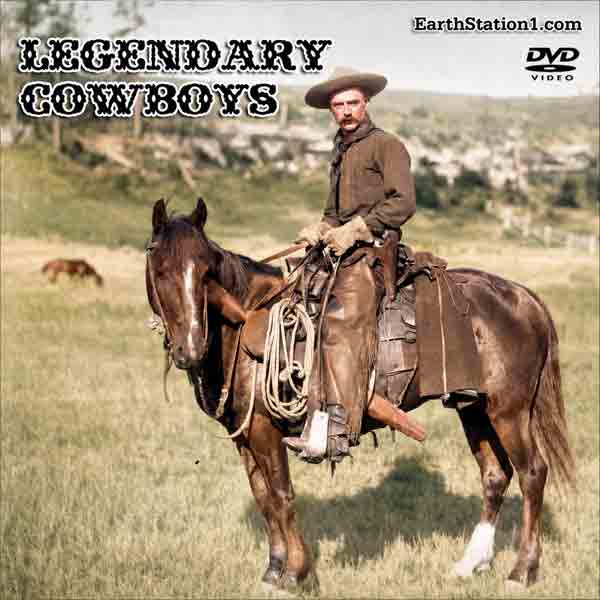
August 21, 1938: #BOTD: #HBD! Kenny
Rogers, American singer, songwriter, actor, record producer, and
entrepreneur (d. March 20, 2020) is #born Kenneth Ray Rogers. He
was elected to the Country Music Hall of Fame in 2013. Rogers was
particularly popular with country audiences but also charted more
than 120 hit singles across various music genres, and topped the
country and pop album charts for more than 200 individual weeks in
the United States alone. He sold over 100 million records
worldwide during his lifetime, making him one of the best-selling
music artists of all time. His fame and career spanned multiple
genres: jazz, folk, pop, rock, and country. He remade his career,
and was one of the most successful cross-over artists of all time.
In the late 1950s, Rogers began his recording career with the
Houston-based group the Scholars, who first released "The
Poor Little Doggie". After some solo releases including
1958's "That Crazy Feeling", Rogers then joined a group
with the jazz singer Bobby Doyle. In 1966 he became a member of
the folk ensemble the New Christy Minstrels, playing double bass
and bass guitar as well as singing. In 1967, he and several
members of the New Christy Minstrels left to found the group the
First Edition, with whom he scored his first major hit, "Just
Dropped In (To See What Condition My Condition Was In)", a
psychedelic rock song which peaked at number five on the Billboard
charts. As Rogers took an increased leadership role in the First
Edition, and following the success of 1969's "Ruby, Don't
Take Your Love to Town", the band gradually changed styles to
a more country feel. The band broke up in 1975-1976, and Rogers
embarked on a long and successful solo career, which included
several successful collaborations, including duets with singers
Dolly Parton and Sheena Easton, and a songwriting partnership with
Lionel Richie. His signature song, 1978's "The Gambler",
was a cross-over hit that won him a Grammy Award in 1980 and was
selected in 2018 for preservation in the National Recording
Registry by the Library of Congress. He would develop the Gambler
persona into a character for a successful series of television
films starting with 1980's Emmy-nominated Kenny Rogers as The
Gambler. Rogers' albums The Gambler and Kenny were featured in the
About.com poll of "The 200 Most Influential Country Albums
Ever". He was voted the "Favorite Singer of All Time"
in a 1986 joint poll by readers of both USA Today and People. He
received numerous awards such as the AMAs, Grammys, ACMs and CMAs,
as well as a lifetime achievement award for a career spanning six
decades in 2003. Later success included the 2006 album release,
Water & Bridges, an across the board hit, that hit the Top 5
in the Billboard Country Albums sales charts, also charting in the
Top 15 of the Billboard 200. The first single from the album, "I
Can't Unlove You", was also a sizable chart hit. Remaining a
popular entertainer around the world, he continued to tour
regularly until his retirement in 2017. Rogers had acting roles in
movies and television shows, including the title roles in Kenny
Rogers as The Gambler and the MacShayne series for The NBC Mystery
Movie, and the 1982 feature film Six Pack. He was the host and
narrator of the highly rated A & E TV documentary series The
Real West from 1991 to 1994, rerun extensively on The History
Channel. He was a co-founder of the restaurant chain Kenny Rogers
Roasters in collaboration with former Kentucky Fried Chicken CEO
John Y. Brown Jr. Although the stores closed in the United States,
they are still a fixture in Asia. Kenny Rogers died at age 81
while under hospice care at his home in Sandy Springs, Georgia. He
is interred in Oakland Cemetery in Atlanta. On Sale Until Midnight
Tonight PT!
https://store.earthstation1.com/legendary-cowboys-of-the-american-wild-west-mp4-video-download-dv4.html
Today's
EarthStation1.com 15% (Or More!) Off Commemorative Memorial Title:
American Art & The Metropolitan Museum 1650-1914 DVD, MP4, USB
Drive
Today, August 21, 2026
August 21, 1920: #BOTD: #HBD! Vincent
Scully, American art historian who was Sterling Professor (highest
academic rank at Yale University, akin to the rank of university
professor at other universities) Emeritus of the History of Art in
Architecture at Yale University, and the author of several books
and both producer and host of documentaries on the subject (d.
November 30, 2017) is #born Vincent Joseph Scully Jr. in New
Haven, Connecticut, where he was raised. Architect Philip Johnson
once described Scully as "the most influential architectural
teacher ever." His lectures at Yale were known to attract
casual visitors and packed houses, and regularly received standing
ovations. Scully was a fierce critic of the 1963 destruction of
New York's original Pennsylvania Station, memorably writing of it
that, "One entered the city like a god. One scuttles in now
like a rat." Scully died on November 30, 2017 at his home in
Lynchburg, Virginia, aged 97. The cause of death was complications
of Parkinson's disease. His burial details are not publicly
disclosed. On Sale Until Midnight Tonight PT!
https://store.earthstation1.com/american-art-and-the-metropolitan-museum-165016501914.html
Today's
EarthStation1.com 15% (Or More!) Off Commemorative Memorial Title:
Leonardo da Vinci Documentary DVD MP4 Video Download USB Flash
Drive
Today, August 21, 2026
August 21, 1911: Crime: Art Thefts: The
Theft Of The Mona Lisa: -- The Mona Lisa is stolen by Louvre
employee Vincenzo Peruggia in what has been described as the
greatest art theft of the 20th century. He entered the museum on
Monday, August 21 around 7 am, through the door where the other
Louvre workers were entering. When the Salon Carre, where the Mona
Lisa hung, was empty, he lifted the painting, which Leonardo
painted on wood, off the four iron pegs that secured it to the
wall and took it to a nearby service staircase. There, he removed
the protective case and frame. Peruggia said he took off his smock
and wrapped it around the painting, tucked it under his arm, and
left the Louvre through the same door he had entered. Peruggia hid
the painting in his apartment in Paris. After keeping the painting
hidden in a trunk in his apartment for two years, Peruggia
returned to Italy with it. He kept it in his apartment in
Florence, Italy for some time. However, Peruggia eventually grew
impatient and was finally caught when he contacted Mario Fratelli,
the owner of an art gallery in Florence. Fratelli's story
conflicts with Peruggia's, but it was clear that Peruggia expected
a reward for returning the painting to what he regarded as its
"homeland". Fratelli called in Giovanni Poggi, director
of the Uffizi Gallery, who authenticated the painting. Poggi and
Fratelli, after taking the painting for "safekeeping",
informed the police, who arrested Peruggia at his hotel. After its
recovery, the painting was exhibited all over Italy with banner
headlines rejoicing its return. The Mona Lisa was then returned to
the Louvre in 1913. While the painting was famous before the
theft, the notoriety it received from the newspaper headlines and
the large scale police investigation helped the artwork become one
of the best known in the world, gaining considerable public
interest. On Sale Until Midnight Tonight PT!
https://store.earthstation1.com/leonardo-da-vinci-documentary-dvd-mp4-video-download-usb-flash-driv4.html
Today's
EarthStation1.com 15% (Or More!) Off Commemorative Memorial Title:
Al Capone Documentary Biography MP4 Video Download DVD
Today, August 21, 2026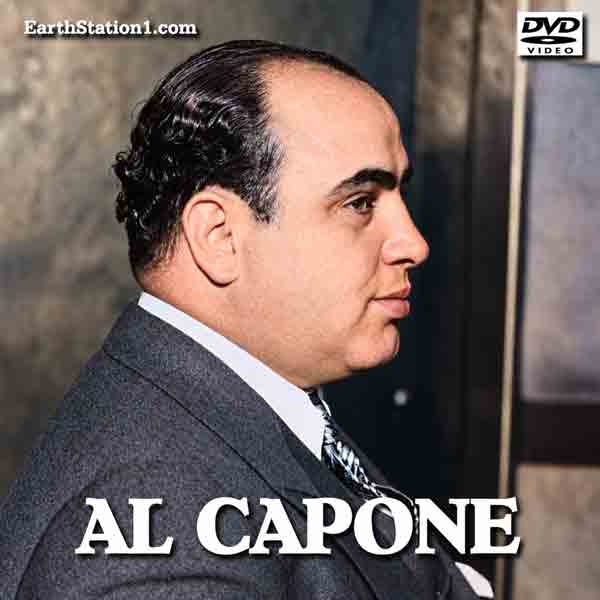
August 21, 1893: #BOTD: Bugs Moran,
American mob boss, Prohibition-era gangster who was head of the
North Side Gang of Chicago, also known as the North Side Mob (d.
February 25, 1957) is #born Adelard Leo Cunin to a French
immigrant father, Jules Adelard Cunin, and a mother of Canadian
descent, Marie Diana Gobeil, in Saint Paul, Minnesota. He was
incarcerated three times before turning 21. On February 14, 1929,
in an event that has become known as the Saint Valentine's Day
Massacre, seven members of his gang were gunned down in a
warehouse, supposedly on the orders of Moran's rival Al Capone.
Moran died of lung cancer a few months into his 10-year sentence
at Leavenworth Prison in Kansas at the age of 63. He is buried at
The United States Penitentiary Cemetery in Leavenworth, Kansas. On
Sale Until Midnight Tonight PT!
https://store.earthstation1.com/al-capone-documentary-biography-mp4-video-download-dv4.html
Today's
EarthStation1.com 15% (Or More!) Off Commemorative Memorial Title:
The Great American Road Automotive History Films MP4 Download DVD
Set
Today, August 21, 2026
August 21, 1897: The History Of The
Automobile: The History Of The Automotive Industry: Oldsmobile: --
Ransom E. Olds founds Oldsmobile, a brand of American automobiles
produced for most of its existence by General Motors. In its
107-year history, it produced over 35 million vehicles, including
at least 14 million built at its Lansing, Michigan factory. When
it was phased out in 2004, Oldsmobile was the oldest surviving
American automobile marque, and one of the oldest in the world,
after Daimler, Peugeot and Tatra. Though it was discontinued, it
still remains an active trademark of the General Motors Company.
The closing of the Oldsmobile division presaged a larger
consolidation of GM brands and discontinuation of models during
the company's 2009 bankruptcy reorganization. It was replaced by
Buick. On Sale Until Midnight Tonight PT!
https://store.earthstation1.com/the-great-american-road-automotive-history-films-2-dvd-se2.html
Today's
EarthStation1.com 15% (Or More!) Off Commemorative Memorial Title:
The Battle Of Guadalcanal DVD MP4 Download USB Flash Drive
Today, August 21, 2026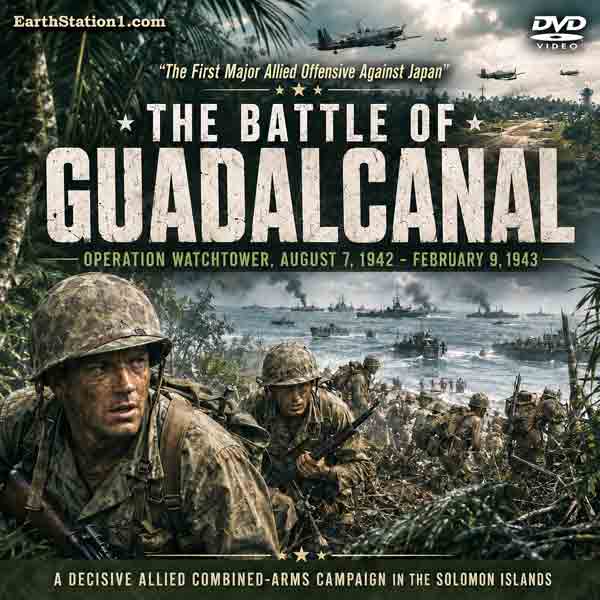
August 21, 1942: World War II: The
Pacific War (The Asia-Pacific War, The Pacific Theater Of World
War II): The Pacific Ocean Theater Of World War II: Operation
Cartwheel: The Solomon Islands Campaign: The Battle Of Guadalcanal
(The Guadalcanal Campaign, Operation Watchtower): The Battle Of
The Tenaru (The Battle Of The Ilu River, The Battle Of Alligator
Creek): -- American forces defeat an attack by Imperial Japanese
Army soldiers in the Battle of the Tenaru. The Battle of the
Tenaru, sometimes called the Battle of the Ilu River or the Battle
of Alligator Creek, was a land battle between the Imperial
Japanese Army and Allied ground forces that took place on August
21, 1942 on the island of Guadalcanal during the Pacific campaign
of World War II. The battle was the first major Japanese land
offensive during the Guadalcanal campaign. On Sale Until Midnight
Tonight PT!
https://store.earthstation1.com/the-battle-of-guadalcanal-dvd-mp4-download-usb-flash-driv4.html
Today's
EarthStation1.com 15% (Or More!) Off Commemorative Memorial Title:
America Goes Over - The Yanks Are Coming! WWI DVD, Download, USB
Drive
Today, August 21, 2026
August 21, 1918: The European Civil War:
World War I: The First European War (The European Theater Of World
War I): The Western Front Of World War I: Battles Of The Somme:
The Second Battle Of The Somme (The Second Battle Of The Somme Of
1918): -- The Second Battle Of The Somme begins, fought till early
September, in the basin of the River Somme. It was part of a
series of successful counter-offensives by British Empire and
United States forces in response to the German Spring Offensive,
after a pause for redeployment and supply. The most significant
feature of the 1918 Somme battles was that with the first Battle
Of The Somme of 1918 having halted what had begun as an
overwhelming German offensive, the second formed the central part
of the Allies' advance to the Armistice of November 11. On Sale
Until Midnight Tonight PT!
https://store.earthstation1.com/america-goes-over--the-yanks-are-coming-wwi-propaganda-dvd.html
Today's
EarthStation1.com 15% (Or More!) Off Commemorative Memorial Title:
Stalin: The Red Tsar Complete 4 Part TV Series DVD, Download, USB
Drive
Today, August 21, 2026
August 21, 1940: The Interwar Period (The
Interbellum, Between The Wars): The Soviet Union (The Union Of
Soviet Socialist Republics, USSR): The History Of The Soviet
Union: Mass Repression In The Soviet Union: Stalinism: The
Assassination Plots Of Joseph Stalin: Assassination Attempts On
Leon Trotsky: The Assassination Of Leon Trotsky: -- #DOTD: Leon
Trotsky, Russian revolutionary, Marxist theorist, and Soviet
politician whose particular strain of Marxist thought is known as
Trotskyism (b. November 7, 1879) #dies aged 60 in exile in Mexico
City from wounds received by an assassination ice axe attack by
Ramon Mercader, a Spanish-born NKVD agent. Mercader acted upon
instruction from Stalin and was nearly beaten to death by
Trotsky's bodyguards the day prior. Mercader spent the next 20
years in a Mexican prison for the murder. Stalin presented
Mercader with an Order of Lenin in absentia. After an ineffectual
attempt to have Trotsky murdered in March 1939, Stalin assigned
the overall organization of implementing the task to the NKVD
officer Pavel Sudoplatov, who in turn co-opted Nahum Eitingon.
According to Sudoplatov's Special Tasks, the NKVD proceeded to set
up three NKVD agent networks to carry out the murder, one of which
relied on Ramon Mercader. According to Sudoplatov, all three
networks were designed to operate entirely autonomously from the
NKVD's hitherto-established spy networks in the U.S. and Mexico.
On May 24, 1940, Trotsky survived a raid on his villa by armed
assassins led by the NKVD agent Iosif Grigulevich and Mexican
painter David Alfaro Siqueiros. Trotsky's 14-year-old grandson,
Vsevolod Platonovich "Esteban" Volkov (born March 7,
1926), was shot in the foot, and a young assistant and bodyguard
of Trotsky, Robert Sheldon Harte, was abducted and later murdered.
Trotsky's other guards fended off the attackers. Following the
failed assassination attempt, Trotsky wrote an article titled
"Stalin Seeks My Death" on June 8, 1940, in which he
states that another assassination attempt is certain. On August
20, 1940, Trotsky was attacked in his study by Mercader, who used
an ice axe as a weapon. The blow to his head was bungled and
failed to kill Trotsky instantly. Witnesses stated that Trotsky
spat on Mercader and began struggling fiercely with him, which
resulted in Mercader's hand being broken. Hearing the commotion,
Trotsky's bodyguards burst into the room and nearly killed
Mercader, but Trotsky stopped them, laboriously stating that the
assassin should be made to answer questions. Trotsky was then
taken to a hospital, operated on, and survived for more than a
day, dying at the age of 60 onAugust 21, 1940 from exsanguination
and shock. Mercader later testified at his trial: " I laid my
raincoat on the table in such a way as to be able to remove the
ice axe which was in the pocket. I decided not to miss the
wonderful opportunity that presented itself. The moment Trotsky
began reading the article, he gave me my chance; I took out the
ice axe from the raincoat, gripped it in my hand and, with my eyes
closed, dealt him a terrible blow on the head. According to James
P. Cannon, the secretary of the Socialist Workers Party (USA),
Trotsky's last words were "I will not survive this attack.
Stalin has finally accomplished the task he attempted
unsuccessfully before." Trotsky, born Lev Davidovich
Bronstein, initially supported the Menshevik Internationalists
faction within the Russian Social Democratic Labour Party. He then
joined the Bolsheviks ("majority") just before the 1917
October Revolution, immediately becoming a leader within the
Communist Party. He would go on to become one of the seven members
of the first Politburo, founded in 1917 to manage the Bolshevik
Revolution. During the early days of the Russian Soviet Federative
Socialist Republic (RSFSR) and the Soviet Union, he served first
as People's Commissar for Foreign Affairs and later as the founder
and commander of the Red Army, with the title of People's
Commissar of Military and Naval Affairs. He became a major figure
in the Bolshevik victory in the Russian Civil War (1918-1922).
After leading a failed struggle of the Left Opposition against the
policies and rise of Joseph Stalin in the 1920s and against the
increasing role of bureaucracy in the Soviet Union, Trotsky was
removed as Commissar for Military and Naval Affairs (January
1925), removed from the Politburo (October 1926), removed from the
Central Committee (October 1927), expelled from the Communist
Party (November 1927), exiled to Alma-Ata (January 1928), and
exiled from the Soviet Union (February 1929). As the head of the
Fourth International, Trotsky continued to oppose the Stalinist
bureaucracy in the Soviet Union while in exile. Trotsky's ideas
formed the basis of Trotskyism, a major school of Marxist thought
that opposes the theories of Stalinism. He was written out of the
history books under Stalin, and was one of the few Soviet
political figures who was not rehabilitated by the government
under Nikita Khrushchev in the 1950s. On Sale Until Midnight
Tonight PT!
https://store.earthstation1.com/stalin-the-red-tsar-dvd-complete-4-part-tv-series-2-dis42.html
Today's
EarthStation1.com 15% (Or More!) Off Commemorative Memorial Title:
The Race For Space 1961 Historic Soviet Space Films DVD, Download,
USB
Today, August 21, 2026
August 21, 1957: Rocket Launches: The
History Of Rocketry: The History Of Spaceflight: Intercontinental
Ballistic Missiles (ICBMs): Intercontinental Ballistic Missiles
(ICBMs) Of The Soviet Union: Maiden Flights: The R-7 Rocket
Family: The R-7 Semyorka (Russian: R-7 Siemiorka): -- The Soviet
Union successfully conducts a long-range 6,000 km (3,700 mi) test
flight of the R-7 Semyorka (Russian: "Digit 7") (GRAU
index 8K71), the first intercontinental ballistic missile, when it
is launched from the Baikonur Cosmodrome. Its dummy nuclear
warhead impacted in the Pacific Ocean, and five days later, TASS
announced that the Soviet Union had "successfully tested a
multi-stage intercontinental ballistic missile". Six weeks
later, a modified version of the missile, the R-7A (GRAU index
8K71PS) placed Sputnik 1 in orbit from Baikonur on October 4, 1957
and Sputnik 2 on November 3, 1957. From then on, the R-7's several
variants have been, and will continue to be for the forseeable
future, the primary launch vehicle used by the Soviets in both
their manned and unmanned space programs up until the present day.
On Sale Until Midnight Tonight PT!
https://store.earthstation1.com/the-race-for-space-dvd-1961-secret-soviet-f1961.html
Today's
EarthStation1.com 15% (Or More!) Off Commemorative Memorial Title:
The Monarchy: British Royal Family History TV Series DVD MP4 USB
Drive
Today, August 21, 2026
August 21, 1930: #BOTD: #HBD! Princess
Margaret, Countess of Snowdon, CI, GCVO, CD (d. February 9, 2002)
is #born Margaret Rose Windsor at Glamis Castle in Scotland, her
mother's ancestral home, and was affectionately known as Margot
within the royal family. She was the first member of the royal
family in direct line of succession to be born in Scotland since
the 1600s. She was the younger daughter of King George VI and
Queen Elizabeth and the only sibling of Queen Elizabeth II.
Margaret spent much of her childhood with her parents and sister.
Her life changed dramatically at the age of six when her paternal
uncle, King Edward VIII, abdicated to marry divorcee Wallis
Simpson. Margaret's father became king and her sister became heir
presumptive, with Margaret second in line to the throne. Her
position in the line of succession diminished over the following
decades as Elizabeth's own children and grandchildren were born.
During the Second World War the two sisters stayed at Windsor
Castle despite suggestions to evacuate them to Canada. During the
war years, Margaret was considered too young to perform any
official duties, and instead continued her education, being nine
years old when the war broke out and turning 15 just after
hostilities ended. From the 1950s onwards, Margaret became one of
the world's most celebrated socialites, famed for her glamorous
lifestyle and reputed romances. Most famously, she fell in love
with Group Captain Peter Townsend as a young adult in the early
1950s. In 1952, her father died, her sister became queen and
Townsend divorced his wife, Rosemary. He proposed to Margaret
early the following year. Many in the government believed that he
would be an unsuitable husband for the Queen's 22-year-old sister,
and the Church of England refused to countenance marriage to a
divorced man. Margaret eventually abandoned her plans with
Townsend and married photographer Antony Armstrong-Jones in 1960;
the Queen made him Earl of Snowdon. The couple had two children,
David and Sarah, before divorcing in 1978. Margaret never
remarried. Margaret was a controversial member of the British
royal family. Her divorce received much negative publicity, and
her private life was for many years the subject of intense
speculation by media and royal-watchers. Her health gradually
deteriorated in the final two decades of her life. She was a heavy
smoker for most of her adult life, and had a lung operation in
1985, a bout of pneumonia in 1993, and at least three strokes
between 1998 and 2001. She died in London on 9 February 2002,
after suffering a fourth and final stroke at the age of 71. She is
buried at St. George's Chapel in Windsor, Windsor and Maidenhead
Royal Borough, Berkshire, England. On Sale Until Midnight Tonight
PT!
https://store.earthstation1.com/the-monarchy-3-part-british-royal-family-tv-series-dvd-mp4-u34.html
Today's
EarthStation1.com 15% (Or More!) Off Commemorative Memorial Title:
The Golden Age Of Rock 'N' Roll DVD, MP4 Video Download, Flash
Drive
Today, August 21, 2026
August 21, 1944: #BOTD: #HBD! Jackie
DeShannon, American singer, songwriter, radio personality and
beauty, one of the first female singer-songwriters of the rock 'n'
roll period, with a string of hit song credits from the 1960s
onwards, as both singer and composer and both, best known as the
singer of "What the World Needs Now Is Love" and "Put
a Little Love in Your Heart", "When You Walk in the
Room" and "Bette Davis Eyes", which were hits for
The Searchers and Kim Carnes, respectively, is #born Sharon Lee
Myers in Hazel, Kentucky.Eddie Cochran arranged for her to travel
to California to meet his girlfriend, singer-songwriter Sharon
Sheeley, who formed a writing partnership with DeShannon in 1960.
Their partnership produced Brenda Lee's hits "Dum Dum"
and "Heart in Hand". DeShannon recorded many other
singles that encompassed teen pop, country ballads, rockabilly,
gospel, and Ray Charles-style soul that did not fare as well on
the charts. During these years it was her songwriting and public
profile rather than her recording career that kept her contracted
to Liberty. DeShannon dated Elvis Presley and formed friendships
with The Everly Brothers and Ricky Nelson. She also co-starred and
sang with Bobby Vinton in the 1964 teen surf movie Surf Party.
DeShannon's biggest break came in 1964 when she supported The
Beatles on their first US tour, and formed a touring band with
guitarist Ry Cooder. DeShannon co-wrote "Breakaway" with
Sharon Sheeley, which was recorded by Irma Thomas in 1964, and by
Tracey Ullman in 1983. She also wrote "Don't Doubt Yourself
Babe" for Mr. Tambourine Man, the 1965 debut album of The
Byrds. Her music at this stage was heavily influenced by the
American West Coast sounds and folk music. Staying briefly in
England in 1965, DeShannon formed a songwriting partnership with
Jimmy Page, which resulted in the songs "Dream Boy" and
"Don't Turn Your Back on Me". DeShannon also wrote
material for singer Marianne Faithfull, including her Top Ten UK
and US hit "Come and Stay With Me", which became
Faithfull's biggest UK hit, peaking at No. 4 in 1965. That same
year, Cher recorded the song on her solo debut album All I Really
Want to Do. It would be three more years before Jackie DeShannon
would record the song for herself, on her Laurel Canyon album in
1968. She also appeared on the television show Ready Steady Go!
Moving to New York City, DeShannon co-wrote with Randy Newman,
producing such songs as "She Don't Understand Him Like I Do"
and "Did He Call Today Mama?", as well as writing "You
Have No Choice" for Delaney Bramlett. In March 1965,
DeShannon recorded Burt Bacharach and Hal David's "What the
World Needs Now Is Love", which led to club tours and regular
appearances on television and went to No. 7 on the US chart and
No. 1 in Canada. (DeShannon's recording of the song was later used
in the 1969 film Bob & Carol & Ted & Alice). She
appeared in the 1967 film C'mon, Let's Live a Little, with Bobby
Vee, as a folk singer. DeShannon continued writing and recording,
but it was not until 1969 that she scored her next smash single
and album, both entitled "Put a Little Love in Your Heart".
The self-penned single (co-written with her brother, Randy Myers
and Jimmy Holiday) sold over one million copies, and was awarded a
gold disc. "Put a Little Love in Your Heart" was
performed as the closing number at the Music for UNICEF Concert,
broadcast worldwide from the United Nations General Assembly in
1979, and was covered in 1988 as a duet by Annie Lennox and Al
Green (reaching No. 9 in the Billboard Hot 100), and by Dolly
Parton in 1993. The single "Love Will Find a Way" from
the same album was also a moderate hit. DeShannon recorded the
critically acclaimed albums Jackie (1972) and Your Baby Is a Lady
(1974), but they failed to produce the same commercial success as
her previous releases. In 1973, she was invited by Van Morrison to
sing on his album Hard Nose the Highway (singing backup on both
the title track and "Warm Love"). In 1974, DeShannon
released New Arrangement for Columbia Records. She co-wrote four
songs on the album with Donna Weiss, including "Queen of the
Rodeo" and "Bette Davis Eyes". The latter went on
to become a worldwide No. 1 single for Kim Carnes in 1981, earning
Weiss and DeShannon the 1982 Grammy Award for Song of the Year.
She released You're the Only Dancer in 1977, and a single from
that album, "Don't Let The Flame Burn Out", was a minor
hit, reaching No. 65 in the Billboard Hot 100. DeShannon continued
to record. She released You Know Me, an album of original songs,
for Varese Sarabande in 2000, and When You Walk in the Room, a new
recording of her best-known songs, in 2011. She was portrayed by
singer Liz Phair in an episode of American Dreams. On June 17,
2010, DeShannon was inducted into the Songwriters Hall of Fame. In
2012 she wrote and recorded "For Africa, In Africa", a
song inspired by the urgent need for action to provide clean water
for the African Continent. Using her continuing access and
friendship with Paul McCartney and Ringo Starr, DeShannon has
appeared as a contributing entertainment broadcast correspondent
reporting historical anecdotes and current touring and personal
news and publicity pertaining to the two surviving Beatles for
Breakfast with the Beatles on Sirius XM Satellite Radio on the
weekends since October 2009. She has a brother, Randy James Myers
and sometimes has written songs with him. In the mid 1960s, she
was a companion of Jimmy Page and dated Love guitarist Bryan
MacLean. It is likely that Page wrote the song "Tangerine"
(which appeared on the third Led Zeppelin album) after the breakup
of his relationship with DeShannon in early 1965. Her first
husband was Liberty Records executive Irving "Bud" Dain,
whom she married on January 29, 1966 (it was annulled in 1967).
DeShannon has been married to singer-songwriter and film composer
Randy Edelman since 1976. They have a son, Noah who was born in
1978. Since 2009, DeShannon has been an entertainment broadcast
correspondent reporting Beatles band members' news for the popular
syndicated radio program "Breakfast With The Beatles".
#JackieDeShannon #SingerSongwriters #Singers #Songwriters
#RockNRoll #RockAndRoll #Pop #PopMusic #MP4 #VideoDownload #DVD On
Sale Until Midnight Tonight PT!
https://store.earthstation1.com/the-golden-age-of-rock-39n39-roll-dvd-complete-tv-series-5-39395.html
Today's
EarthStation1.com #OnThisDay Commemorative Memorial Title: Dwight
D. Eisenhower: In War And Peace DVD, Video Download, USB Drive
Today, August 21, 2026 August 21, 1959: Statehood Day (Admission
Day, Hawaii Admission Day): -- President Dwight D. Eisenhower
signed a proclamation admitting Hawaii to the Union as the 50th
state. Hawaii's admission is currently commemorated by Hawaii
Admission Day, also known as Statehood Day or Admission Day, a
legal holiday in the state of Hawaii, celebrated annually on the
third Friday in August. Statehood bills for Hawaii were introduced
into the U.S. Congress as early as 1919 by Prince Jonah Kuhio
Kalanianaole, the non-voting delegate sent by the Territory of
Hawaii to the U.S. Congress. Additional bills were introduced in
1935, 1947 and 1950. In 1959, the U.S. Congress approved the
statehood bill, the Hawaii Admission Act. This was followed by a
referendum in which Hawaiian residents voted 94% in support of
statehood (the ballot question was: "Shall Hawaii immediately
be admitted into the Union as a state?"), and on August 21,
1959 (the third Friday in August), President Dwight D. Eisenhower
signed a proclamation making Hawaii the 50th state.
https://store.earthstation1.com/dwight-d-eisenhower-documentaries-dual-layer-dvd.html
Today's
EarthStation1.com #OnThisDay Commemorative Memorial Title: The
Rise And Fall Of Ceausescu Documentary DVD, Download, USB Drive
Today, August 21, 2026August 21, 1968: The Aftermath Of World
War II: The Cold War: The Cold War (1962-1979): The Era Of
Stagnation (1964-1982): Counterculture Of The 1960s: The Protests
Of 1968: The Prague Spring: The Warsaw Pact Invasion Of
Czechoslovakia: Nicolae Ceausescu's Speech Of August 21, 1968: --
In what became one of his most famous speeches, Nicolae Ceausescu,
General Secretary of the Romanian Communist Party and President of
the State Council of Romania, boldly denounced the Warsaw Pact
invasion of Czechoslovakia in a public address before 100,000
people in Palace Square in Bucharest, declaring that it was a
"grave error and constituted a serious danger to peace in
Europe and for the prospects of world socialism". His address
was perceived as a bold gesture of disobedience to the Soviet
Union both at home and abroad. The speech was part of the Romanian
government's efforts since 1956 to assert its independence
vis-a-vis Moscow. Ceausescu's response consolidated Romania's
independent voice in the next two decades, especially since
Ceausescu encouraged the population to take up arms to meet any
similar maneuver in the country. He received an enthusiastic
initial response, with many people being willing to enroll in the
newly-formed paramilitary Patriotic Guards. While it resulted in a
surge in popularity domestically and internationally, it was
brief, as his government soon became totalitarian and came to be
considered the most repressive in all of the Eastern Bloc.
https://store.earthstation1.com/the-rise-and-fall-of-ceausescu-dvd.html
Today's
EarthStation1.com #OnThisDay Commemorative Memorial Title: The
Everly Brothers' Rock 'N' Roll Odyssey MP4 Video Download DVD
Today, August 21, 2026August 21, 2021: #DOTD: #RIP: Don Everly,
American singer-songwriter and guitarist, one half of the duo The
Everly Brothers alongside his younger brother Phil (b. February 1,
1937) #dies at his home in Nashville, Tennessee, aged 84. His
remains were cremated, and the ashes were scattered in The Green
River, a 384-mile-long (618 km) tributary of the Ohio River that
rises in Lincoln County in south central Kentucky. Don Everly was
born Isaac Donald Everly in Brownie, Muhlenberg County, Kentucky.
The Everly Brothers were an American country-influenced rock and
roll duo, known for steel-string acoustic guitar playing and close
harmony singing. Consisting of Isaac Donald "Don" Everly
and Phillip "Phil" Jason Everly, the duo was raised in a
musical family, first appearing on radio singing along with their
father Ike Everly and mother Margaret Everly as "The Everly
Family" in the 1940s. When the brothers were still in high
school, they gained the attention of prominent Nashville musicians
like Chet Atkins, who began to groom them for national attention.
They began writing and recording their own music in 1956, and
their first hit song came in 1957, with "Bye Bye Love",
written by Felice and Boudleaux Bryant. The song hit No. 1 in the
spring of 1957, and additional hits would follow through 1958,
many of them written by the Bryants, including "Wake Up
Little Susie", "All I Have to Do Is Dream", and
"Problems". In 1960, they signed with the major label
Warner Bros. Records and recorded "Cathy's Clown",
written by the brothers themselves, which was their biggest
selling single. The brothers enlisted in the United States Marine
Corps Reserve in 1961, and their output dropped off, though
additional hit singles continued through 1962, with "That's
Old Fashioned (That's the Way Love Should Be)" being their
last top-10 hit. Long-simmering disputes with Wesley Rose, the CEO
of Acuff-Rose Music, which managed the group, a growing drug usage
in the 1960s, as well as changing tastes in popular music, led to
the group's decline in popularity in its native U.S., though the
brothers continued to release hit singles in the U.K. and Canada,
and had many highly successful tours throughout the 1960s. In the
early 1970s, the brothers began releasing solo recordings, and in
1973 they officially broke up. Starting in 1983, the brothers got
back together, and would continue to perform periodically until
Phil's death in 2014. The group was highly influential on the
music of the generation that followed it. Many of the top acts of
the 1960s were heavily influenced by the close-harmony singing and
acoustic guitar playing of the Everly Brothers, including the
Beatles, the Beach Boys, the Bee Gees, and Simon & Garfunkel.
Rolling Stone ranked the Everly Brothers No. 1 on its list of the
20 Greatest Duos of All Time. They were inducted into the Rock and
Roll Hall of Fame as part of the inaugural class of 1986, and into
the Country Music Hall of Fame in 2001. Don was inducted into the
Musicians Hall of Fame and Museum in 2019, earning the
organization's first Iconic Riff Award for his distinctive rhythm
guitar intro to the Everlys' massive 1957 hit "Wake Up Little
Susie".
https://store.earthstation1.com/everly-brothers-rock-39n39-roll-odyssey3939.html
Today's
EarthStation1.com #OnThisDay Commemorative Memorial Title: Ethnic
Notions + The Mammy Legend: Black Stereotypes DVD MP3 USB Drive
Today, August 21, 2026August 21, 2024: #DOTD: #RIP: John Amos,
African American actor, best known for his role as James Evans Sr.
on the CBS television series Good Times (b. December 27, 1939)
#dies of congestive heart failure at Centinela Hospital Medical
Center in Inglewood, California, aged 84; it is only announced
publicly by his publicist in a statement a full five weeks later
on October 1. His daughter, Shannon, was unaware that he had died
until it was reported by the media. His remains were cremated nine
days after his death; the final disposition of his ashes are not
publicly disclosed. John Amos was born John Allen Amos Jr. in
Newark, New Jersey. Amos's other television work includes The Mary
Tyler Moore Show, a recurring role as Admiral Percy Fitzwallace on
The West Wing, and the role of Washington, D.C., Mayor Ethan Baker
in the series The District. Amos has appeared on Broadway and in
numerous films in his five-decade career. He has been nominated
for a Primetime Emmy Award and an NAACP Image Award. On film, he
has played numerous supporting roles in movies such as The
Beastmaster (1982), Coming to America (1988), Die Hard 2 (1990)
and Coming 2 America (2021).
https://store.earthstation1.com/ethnic-notions-africanamerican-stereotypes-dvd.html
Today's
EarthStation1.com #OnThisDay Commemorative Memorial Title: I Want
My Music TV! 1980s Music Television Videos MP4 Download DVD Set
Today, August 21, 2026August 21, 2005: #DOTD: #RIP: Robert
Moog, American engineer, electronic music pioneer and businessman,
inventor of the Moog synthesizer (b. May 23, 1934) #dies at the
age of 71 in Asheville, North Carolina from a brain tumor. He is
buried at Lou Pollock Memorial Park cemetery in Asheville. Robert
Moog was born Robert Arthur Moog at Flushing Hospital in New York
City to George Conrad Moog, of German descent, and Shirley
(Jacobs) Moog, of Polish-Jewish descent. He was raised in
Flushing, Queens. He was the founder of the synthesizer
manufacturer Moog Music and the inventor of the first commercial
synthesizer, the Moog synthesizer, which debuted in 1964. In 1970,
Moog released a more portable model, the Minimoog, described as
the most famous and influential synthesizer in history. Among
Moog's honors are a Technical Grammy Award, received in 2002, and
an induction into the National Inventors Hall of Fame. By 1963,
Moog had been designing and selling theremins for several years
while working toward a PhD in engineering physics at Cornell
University. He developed his synthesizer in response to demand for
more practical and affordable electronic-music equipment, guided
by suggestions and requests from composers. Moog's principal
innovation was the voltage-controlled oscillator, which uses
voltage to control pitch. He also introduced fundamental
synthesizer concepts such as modularity, envelope generation and
the pitch wheel. He is credited with introducing synthesizers to a
wider audience and influencing the development of popular music.
Moog pursued his work as a hobby, and he is regarded as a poor
businessman. His only patent was on his transistor ladder filter
design; commentators have speculated that he would have become
extremely wealthy had he patented his other innovations, but that
their availability in the public domain helped the synthesizer
industry flourish. In 1971, Moog sold Moog Music to Norlin Musical
Instruments, where he remained as a designer until 1977. In 1978,
he founded the company Big Briar, and in 2002 he renamed it Moog
Music after reacquiring the rights to the name. In later years,
Moog taught at the University of North Carolina at Asheville and
continued designing instruments for the revived Moog Music.
https://store.earthstation1.com/i-want-my-music-tv-dvd-late-1980s-vi1980.html
Today's
EarthStation1.com #OnThisDay Commemorative Memorial Title: The Cat
And The Canary 1927 Laura La Plante Creighton Hale DVD MP4 USB
Today, August 21, 2026August 21, 1889: #BOTD: #HBD! Forrest
Stanley, American actor and screenplay writer best known for his
work in silent film (d. August 27, 1969) is #born in New York
City. He is particularly known for his role as Charles Brandon in
the historical film When Knighthood Was In Flower (1922) by Robert
G. Vignola, and especially known as Charles Wilder in the murder
mystery film The Cat And The Canary (1927), an American silent
horror film adaptation of John Willard's 1922 black comedy play of
the same name. Directed by German Expressionist filmmaker Paul
Leni, the film stars Laura La Plante as Annabelle West, Forrest
Stanley as Charles "Charlie" Wilder, and Creighton Hale
as Paul Jones. The plot revolves around the death of Cyrus West,
who is Annabelle, Charlie, and Paul's uncle, and the reading of
his will 20 years later. Annabelle inherits her uncle's fortune,
but when she and her family spend the night in his haunted mansion
they are stalked by a mysterious figure. Meanwhile, a lunatic
known as "the Cat" escapes from an asylum and hides in
the mansion. The film is part of a genre of comedy horror films
inspired by 1920s Broadway stage plays. Paul Leni's adaptation of
Willard's play blended expressionism with humor, a style Leni was
notable for and critics recognized as unique. Leni's style of
directing made The Cat and the Canary influential in the "old
dark house" genre of films popular from the 1930s through the
1950s. The film was one of Universal's early horror productions
and is considered "the cornerstone of Universal's school of
horror." The play has been filmed five other times, with the
most notable in 1939 starring comedic actor Bob Hope and Paulette
Goddard. Forrest Stanley dies on August 27, 1969 in Los Angeles,
California, aged 80. He is buried at Holy Cross Cemetery in Culver
City, Los Angeles County, California.
https://store.earthstation1.com/the-cat-and-the-canary-1927-dvd-paul-leni-laura-la-pl1927.html
Today's
EarthStation1.com #OnThisDay Commemorative Memorial Title: The
Beatles Live At Shea Stadium 1965 DVD MP4 Download USB Flash Drive
Today, August 21, 2026August 21, 2013: #DOTD: #RIP: Sid
Bernstein, American record producer, music promoter, talent
manager, impresario and author (b. August 12, 1918) #dies in
Manhattan, New York City, nine days after his 95th birthday. He
was survived by his wife Geraldine Gale; and their four sons, two
daughters and six grandchildren. He is buried at Green-Wood
Cemetery in Brooklyn, New York. Sid Bernstein was born in New York
City, named Sidney Bernstein, and was adopted by a Russian Jewish
family. Having worked as a booking agent for pop stars such as
Dion and Chubby Checker, Bernstein changed the American music
scene in the 1960s by bringing the British Invasion rock groups
Beatles, the Rolling Stones, Herman's Hermits, the Moody Blues,
and the Kinks to America. He was the first impresario to organize
rock concerts at sports stadiums. On August 15, 1965, Bernstein
booked The Beatles Shea Stadium Concert, where The Beatles played
to nearly 60,000 fans at Shea Stadium in New York City, an event
later regarded as the birth of stadium rock. It was the opening
show of the 1965 Beatles Tour. It was record-breaking, and one of
the most famous concert events of its era. It set records for
attendance and revenue generation. Promoter Bernstein said, "Over
55,000 people saw the Beatles at Shea Stadium. We took 304K USD,
the greatest gross ever in the history of show business." It
remained the highest concert attendance in the United States until
1973, when Led Zeppelin played to an audience of 56,000 in Tampa,
Florida. This demonstrated that outdoor concerts on a large scale
could be successful and profitable.
https://store.earthstation1.com/the-beatles-live-at-shea-stadium-19651965.html
Today's
EarthStation1.com #OnThisDay Commemorative Memorial Title: Jean
Shepherd Radio Shows All Known To Exist DVD, MP3 Download, USB
Today, August 21, 2026August 21, 1947: #DOTD: #RIP: Ettore
Bugatti, Italian born French engineer, automobile designer and
manufacturer, and businessman, founder of Bugatti Automobiles
(Italian: Automobiles Ettore Bugatti) (b. September 15, 1881)
#dies at the American hospital in the inner-Paris suburb of
Neuilly, France, aged 65. Afflicted by a paralysis of his mental
faculties, he died while unconcious. Bugatti was buried in the
Bugatti family plot at the municipal cemetery in Dorlisheim near
Molsheim in the Bas-Rhin departement of France. Molsheim's Musee
de la Chartreuse houses a section dedicated to his life, work, and
legacy. He was born Ettore Arco Isidoro Bugatti into an artistic
family in Milan, Italy. He is remembered as the founder and
proprietor of the high performance, artisticallly designed
automobile manufacturing company Automobiles E. Bugatti, which he
founded in 1909 in the then German town of Molsheim in the Alsace
region of what is now France.
https://store.earthstation1.com/complete-jean-shepherd-radio-and-lp-collection-mp3-dvds-2-dis32.html
Today's
EarthStation1.com #OnThisDay Commemorative Memorial Title: US
Fleet Submarines Of The Pacific War MP4 Video Download DVD
Today, August 21, 2026August 21, 1941: Naval History: The
History Of The United States Navy: The New United States Navy (The
New Navy, The United States Navy 1885-Present): Naval Launches:
Submarines (Subs): The USS Gato (SS-212): -- USS Gato, the lead
ship of the United States Navy's Gato-class submarines, the first
mass-production U.S. submarine class of World War II, who along
with the closely related Balao and Tench classes that followed
accounted for most of the Navy's World War II submarines,
destroying much of the Japanese merchant marine and a large
portion of the Imperial Japanese Navy, is launched, sponsored by
Mrs. Louise Ingersoll, wife of Admiral Royal E. Ingersoll. Her
keel was laid down on October 5, 1940 by the Electric Boat Company
at Groton, Connecticut, and she was commissioned December 31,
1941. Gato's name comes from a species of small catshark. Like
most other U.S. Navy submarines of the period, ships of the Gato
class were given the names of aquatic creatures. Like all of the
Gatos (with one exception, Dorado), she went on to fight in the
Pacific Theater of Operations. After shakedown at New London,
Connecticut, Gato departed February 16, 1942 via the Panama Canal
for San Francisco, California, where she underwent additional
training. She was at periscope depth while conducting a trim dive
in the Pacific Ocean off the entrance to San Francisco Bay on
March 23, 1942 when the U.S. Navy TC-class blimp TC-13 mistook her
for a Japanese submarine and attacked her with four 325-pound (147
kg) depth charges. The first two depth charges landed within 50
yards (46 m) of her periscope and the second pair exploded as she
dived to a depth of 120 feet (37 m). She suffered extensive damage
but no casualties. It was the only friendly fire incident between
a U.S. Navy blimp and a submarine during World War II. After
repairs at Mare Island Navy Yard in California, Gato was ready for
sea again on March 27, 1942. She subsequently proceeded to Pearl
Harbor, Hawaii. She went on to conduct thirteen war patrols,
sinking many ships and rescuing pilots, and received 13 battle
stars and a Presidential Unit Citation. She received word of the
"Cease Fire" on August 15, 1945 in the midst of making
an attack approach on a Japanese "Su-Ki" sea truck, an
amphibious truck that could transport supplies directly from cargo
ships to the shore and beyond. USS Gato steamed into Tokyo Bay on
August 31, 1945 and remained for the signing of surrender
documents on board Missouri on September 2. USS Gato departed the
following day, and proceeded via Pearl Harbor and the Panama Canal
to the New York Naval Shipyard in Brooklyn, New York, where she
was decommissioned on March 16, 1946. She served for a number of
years as a United States Naval Reserve training vessel at New York
City and later at Baltimore, Maryland, until she was stricken from
the Naval Vessel Register on March 1, 1960. She was sold to the
Northern Metals Company of Philadelphia, Pennsylvania on July 25,
1960 for scrapping. The Gato-class design, with a top range of
11,000 nautical miles (20,000 km), was a near-duplicate of the
preceding Tambor- and Gar-class ships. 77 were produced, of which
20 were lost, 57 and 6 preserved. The Gato-class submarines had
numerous crew comforts including showers, air conditioning,
refrigerated storage for food, generous freshwater distilling
units, clothes washers, and bunks for nearly every crew member;
these were luxuries virtually unheard of in other navies. The
bureau designers felt that if a crew of 60-80 men were to be
expected to conduct 75-day patrols in the warm waters of the
Pacific, these types of features were vital to the health and
efficiency of the crew, and they could be added without impacting
the ship's war fighting abilities due to its extra room as a big
fleet ship. Once they began to arrive in theater in large numbers
in mid-to-late 1942, the Gatos were in the thick of the fight
against the Japanese. Many of these ships racked up impressive war
records: Flasher, Rasher, and Barb were second, third, and fourth
based on tonnage sunk by U.S. submarines. Silversides, Flasher,
and Wahoo were third, fourth, and seventh place on the list for
the number of ships sunk. Gato-class ships sank four Japanese
submarines: I-29, I-168, I-351, and I-42; while only losing one in
exchange, Corvina to I-176. Their principal weapon was the
steam-powered Mark 14 torpedo in the early war years, with the
electric Mark 18 torpedo supplementing the Mark 14 in late 1943.
Due to a stunted research-and-development phase in the
Depression-era 1930s, and in great part due to the arrogance and
stubbornness of its designer, the Naval Torpedo Station Newport
under the Bureau of Ordnance, the "wonder weapon" Mark
14 proved to be full of bugs and very unreliable. They tended to
run too deep, explode prematurely, run erratically, or fail to
detonate. Bowing to pressure from the submariners in the Pacific,
the bureau eventually acknowledged the problems in the Mark 14 and
largely corrected them by late 1943. The Mark 18 electric torpedo
was a hastily copied version of captured German G7e torpedoes and
was rushed into service in the fall of 1943. Unfortunately, it
also was full of faults, the most dangerous being a tendency to
run in a circular pattern and come back at the sub that fired it.
Once perfected, both types of torpedoes proved to be reliable and
effective weapons, allowing the Gatos and other submarines to sink
an enormous amount of Japanese shipping by the end of the war.
https://store.earthstation1.com/us-fleet-submarines-of-the-pacific-war-mp4-video-download-dvd.html
Today's
EarthStation1.com #OnThisDay Commemorative Memorial Title: To The
Moon: The Story In Sound Set CD, MP3 Download, USB Flash Drive
Today, August 21, 2026August 21, 1965: Rocket Launches: The
History Of Rocketry: The History Of Spaceflight: The Aftermath Of
World War II: The Cold War: The Space Age: The Space Race: Space
Programs Of The United States: Human Spaceflight Programs: Project
Gemini: Gemini 5: -- Gemini 5 (officially Gemini V) is launched
atop a Titan II GLV (Gemini Launch Vehicle) (Gemini-Titan II) at
13:59:59 UTC from Cape Kennedy's Launch Complex 19 (LC-19), which
flew from August 21 to 29, 1965. Gemini V was commanded by Gordon
Cooper, who flew in the Mercury program, and included Pete Conrad,
who later walked on the moon in Project Apollo. Gemini V was the
third manned Gemini flight, the eleventh manned American flight,
and the nineteenth spaceflight of all time, including two X-15
flights above 100 kilometers (54 nmi). It was also the first time
an American manned space mission held the world record for
duration, set on August 26, 1965, by breaking the Soviet Union's
previous record set by Vostok 5 in 1963. Gemini 5 splashed down in
the Atlantic Ocean at 12:55:13 UTC on August 29, 1965, and was
recovered by the USS Lake Champlain, an Essex class aircraft
carrier that served in World War II.
https://store.earthstation1.com/to-the-moon-the-story-in-sound-complete-6-album-set-mp3-63.html
Today's
EarthStation1.com #OnThisDay Commemorative Memorial Title:
Monarchy In The UK: British Royal History DVD, Download, USB Drive
Today, August 21, 2026August 21, 1765: #BOTD: #HBD! William IV,
King Of The United Kingdom Of Great Britain And Ireland, King Of
Hanover from June 26, 1830 until his death. nicknamed "The
Sailor King" (d. June 20, 1837) is #born William Henry
Hanover in the early hours of the morning at Buckingham House
(modern Buckingham Palace), the third child and son of King George
III and Queen Charlotte. He had two elder brothers, George, Prince
of Wales, and Prince Frederick (later Duke of York and Albany) and
was not expected to inherit the Crown. William succeeded his elder
brother George IV, becoming the last king and penultimate monarch
of Britain's House Of Hanover. William served in the Royal Navy in
his youth, spending time in British North America and the
Caribbean,. In 1789, he was created Duke Of Clarence and St
Andrews. Between 1791 and 1811, he cohabited with the courtesan
actress Dorothea Jordan, with whom he had ten children, all of
whom took the surname FitzClarence. In 1818, he married Princess
Adelaide of Saxe-Meiningen. William remained faithful to Adelaide
during their marriage. In 1827, he was appointed Britain's first
Lord High Admiral since 1709. As his two elder brothers died
without leaving legitimate issue, William inherited the throne
when he was 64 years old. His reign saw several reforms: the Poor
Law was updated, child labour restricted, slavery abolished in
nearly all of the British Empire, and the electoral system
refashioned by the Reform Acts of 1832. Although William did not
engage in politics as much as his brother or his father, he was
the last British monarch to appoint a prime minister contrary to
the will of Parliament. He granted his German kingdom a
short-lived liberal constitution. William had no surviving
legitimate children at the time of his death, so he was succeeded
by his niece Victoria in the United Kingdom and his brother Ernest
Augustus in Hanover. Both Kine William and Queen Adelaide were
fond of their niece, Princess Alexandrina Victoria Of Kent, the
future Queen Victoria. Their attempts to forge a close
relationship with the girl were frustrated by the conflict between
the King and Victoria's widowed mother, the Duchess Of Kent And
Strathearn. The King, angered at what he took to be disrespect
from the Duchess to his wife, took the opportunity at what proved
to be his final birthday banquet in August 1836 to settle the
score. Speaking to those assembled at the banquet, who included
the Duchess and Princess Victoria, William expressed his hope that
he would survive until Victoria was 18 so that her mother the
Duchess would never be regent. He said, "I trust to God that
my life may be spared for nine months longer ... I should then
have the satisfaction of leaving the exercise of the Royal
authority to the personal authority of that young lady, heiress
presumptive to the Crown, and not in the hands of a person now
near me, who is surrounded by evil advisers and is herself
incompetent to act with propriety in the situation in which she
would be placed." The speech was so shocking that Victoria
burst into tears, while her mother sat in silence and was only
with difficulty persuaded not to leave immediately after dinner
(the two left the next day). William's outburst undoubtedly
contributed to Victoria's tempered view of him as "a good old
man, though eccentric and singular". William survived, though
mortally ill, to the month after Victoria's coming of age. "Poor
old man!", Victoria wrote as he was dying, "I feel sorry
for him; he was always personally kind to me." William was
"very much shaken and affected" by the death of his
eldest daughter, Sophia, Lady de L'Isle and Dudley, in childbirth
in April 1837. Queen Adelaide attended the dying William
devotedly, not going to bed herself for more than ten days.
William died in the early hours of the morning at Windsor Castle,
aged 71 where he was buried in the Royal Vault at St George's
Chapel. His niece, Alexandrina Victoria Hanover, succeeded to his
throne as Queen Victoria, Queen Of The United Kingdom Of Great
Britain And Ireland upon his death, reigning until her own death
64 years later, the longest reign in British history until that
time, a time that later became known as The Victorian Era of
British history; on May 1, 1876, Victoria adopted the additional
title of Empress of India.
https://store.earthstation1.com/monarchy-in-the-uk-british-royal-family-history-films-dvd.html
Today's
EarthStation1.com #OnThisDay Commemorative Memorial Title: KTLA:
The First 35 Years: Los Angeles TV Station Channel 5 DVD MP4 USB
Today, August 21, 2026August 21, 1945: #BOTD: #HBD! Kathy
Fiscus, a three-year-old girl who died after falling into a well
in San Marino, California (d. April 8, 1949) is #born Kathryn Anne
Fiscus. The attempted rescue, broadcast live on KTLA, was a
landmark event in American television history. On the afternoon of
April 8, 1949, Kathy was playing with her nine-year-old sister,
Barbara, and cousin, Gus, in a field in San Marino when she fell
down the 14-inch-wide (360 mm) shaft of an abandoned water well.
Her father, David, worked for the California Water and Telephone
Co., which had drilled the well in 1903. He had recently testified
before the state legislature for a proposed law that would require
the cementing of all old wells. Within hours, a major rescue
effort was underway with drills, derricks, bulldozers, and trucks
from a dozen towns, three giant cranes, and 50 floodlights from
Hollywood studios. At one point a rope was lowered to her but she
could not maintain her hold on it and fell even further down the
well. After digging down 100 feet, workers reached Kathy on Sunday
(April 10) night. It was immediately apparent that Kathy was dead.
It was impossible to move her because of the position of her legs.
A rope was lowered from the top of the well and tied around her to
gently pull her into a different posture from which Dr. Robert
McCullock, one of the Fiscus family physicians, working from the
lateral shaft, was able to free her. Contractor Bill Yancey
brought her to the surface. Kathy's family was informed
immediately. Over an hour later Dr. Paul Hanson made this
statement to the more than 10,000 people who had gathered to watch
the rescue: "Kathy is dead and apparently has been dead since
she was last heard speaking on Friday. Her family has been
notified and we are now notifying you. Dr. McCullock has
pronounced Kathy dead and is assisting in the removal of the body.
For the sake of the family who have held up so gallantly through
this ordeal - and for all the people who have aided so
magnificently, we ask you please to leave the scene of the
accident as a courtesy to them. If this had been your child, we
are sure you would not want a crowd remaining at the scene of the
tragedy." He then read a message from her family: "There
is nothing we can say to fully thank the many people who have
helped us so selflessly. Many of these people have gone home to
much-needed rest. Our heartfelt gratitude goes out to them for the
many sacrifices beyond belief. Thank you very much." It was
determined that she died shortly after the second fall, from a
lack of oxygen. The failed rescue attempt received nationwide
attention in the US as it was carried live on radio and on
television - a still-new medium - by station KTLA and their
reporter Stan Chambers at the beginning of his career. It is
regarded as a watershed event in live TV coverage. Stan Chambers
devoted two chapters to it in his book KTLA's News at 10 and added
"Historians in 1994 agree that the Kathy Fiscus telecast
marked the beginning of the long form of television news
coverage." Kathy's story was recalled nearly 40 years later
during the successful 1987 rescue of Jessica McClure. The location
of the well is on the upper field of San Marino High School and is
unmarked except for a cap covering the opening. Kathy is buried at
Glen Abbey Memorial Park in Bonita, California. The inscription on
her marker reads, "One Little Girl Who United the World for a
Moment". Country singer Jimmie Osborne wrote and recorded the
1949 song "The Death of Little Kathy Fiscus" (King 788).
It sold over one million copies and Osborne donated half the
proceeds to the Fiscus family. Other artists recorded versions of
the song, including Kitty Wells and Howard Vokes. Woody Allen
fictionalized Kathy's tragedy in his 1987 film Radio Days. In it a
little girl named Polly Phelps falls into a well near Stroudsburg,
Pennsylvania. It becomes a big national story and, like Kathy, she
does not survive. The Well (1951), Billy Wilder's 1951 film Ace in
the Hole, and the 1959 Jack Webb film -30- were also partially
inspired by the event. In Rumer Godden's 1969 novel In This House
of Brede, a highly placed British government administrator takes
the veil in an enclosed house of Benedictines after the death of
her son in a similar incident. An episode of Irwin Allen's series
Land of the Giants, "Rescue", is said to be based on the
event.
https://store.earthstation1.com/ktla-the-first-35-years-tv-channel-5-la-355.html